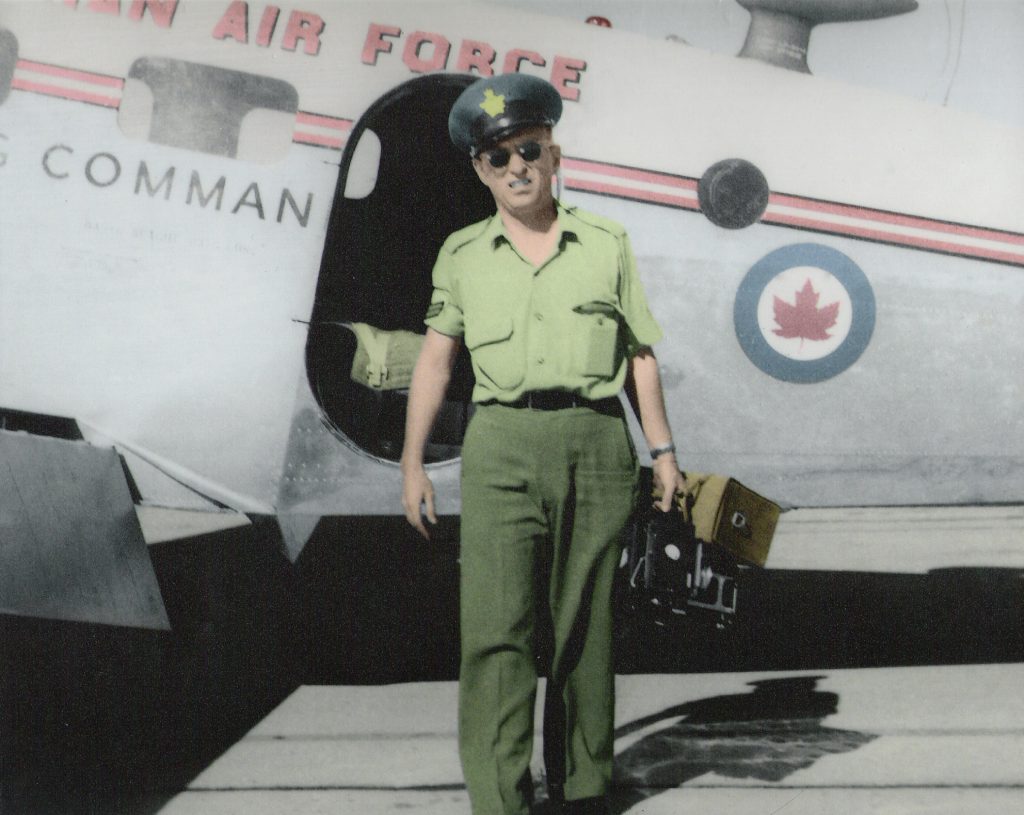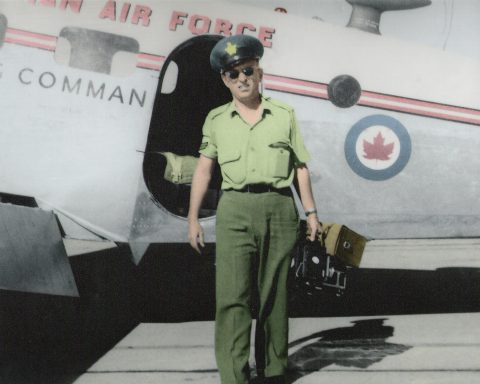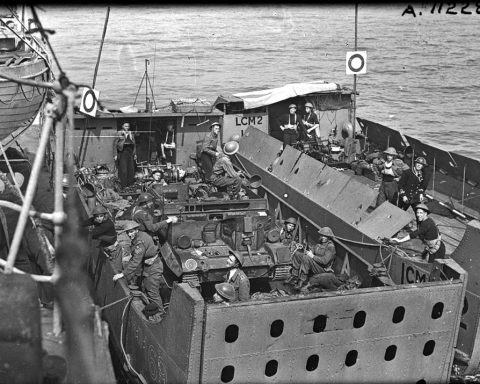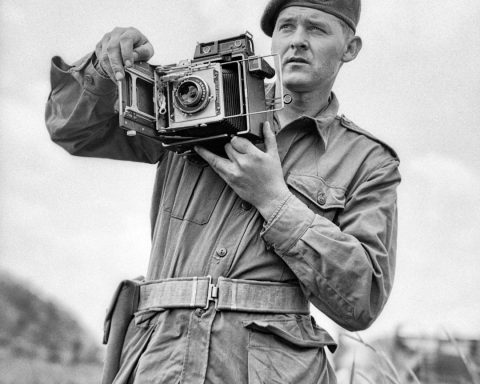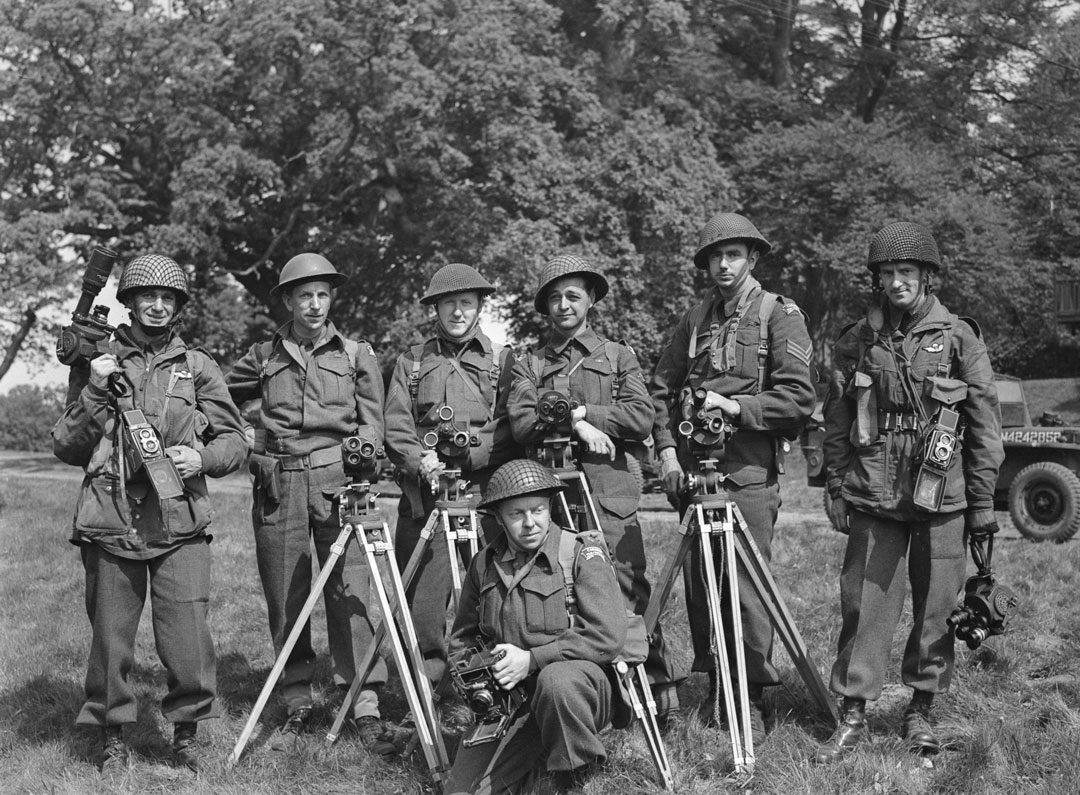

For this post, I am replying to a couple of requests seeking information to help researchers, and re-enactors alike, (hopefully in time for Remembrance Day on NOV. 11), in defining the gear and dress of the Canadian Army Film & Photo Unit cameramen. I have also gathered several posts written by contributors to this website, along with archival photographs, and video, to help with examining the ‘look‘ of a Film Unit cameraman.

As an appropriate start to fully understanding the ‘look‘ of Canadian combat cameramen during WWII, I decided to focus on a few of the D-Day team from the above photo, in their preparation for D-Day…
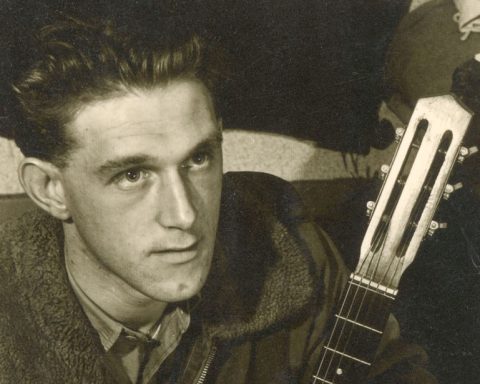
SGT. E. R. BONTER
Sgt. Bonter, trained as a paratrooper and was attached to the 1st Canadian Parachute Battalion (British 6th Airborne Division) in late 1943 for airborne camera operations. Because he trained directly with paratroopers, his uniform and equipment showcase the airborne insignia with specialized technical gear.

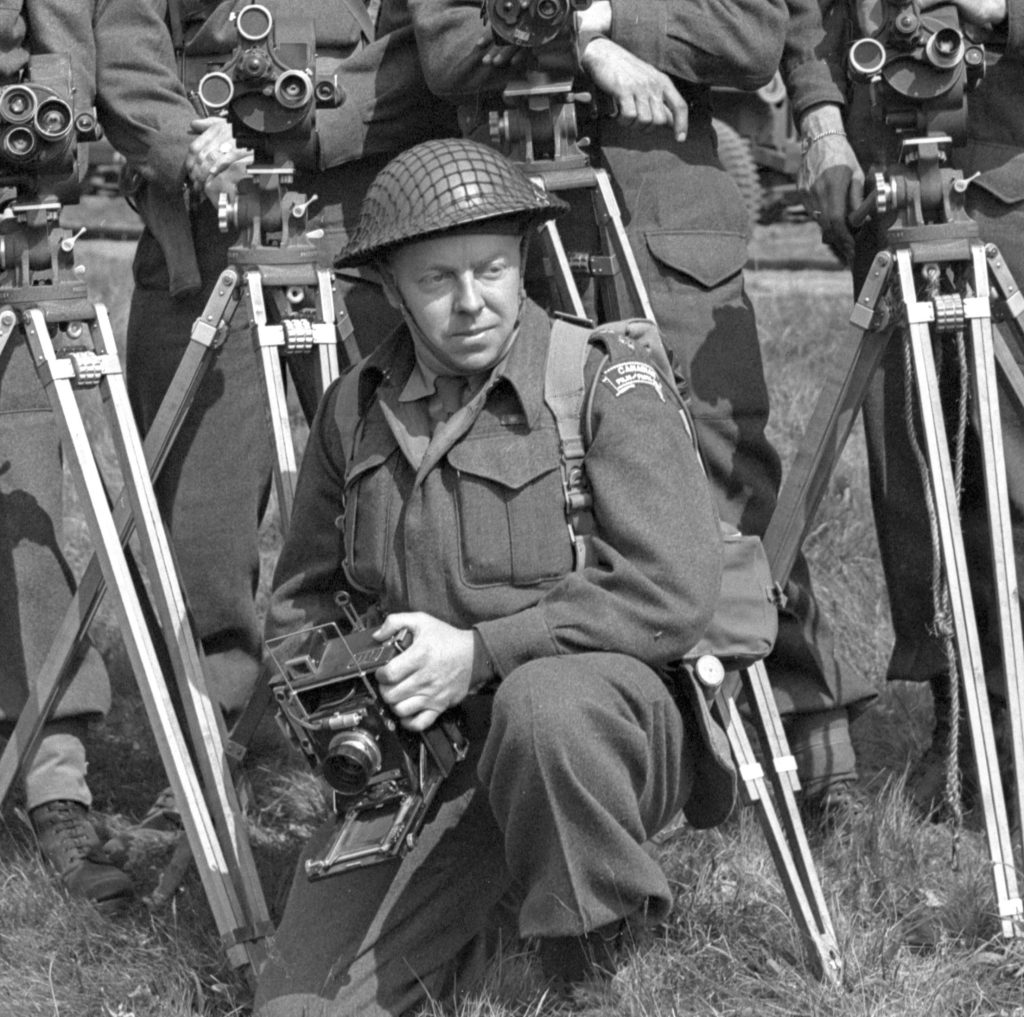
The camera gear is on full display in this Public Realtions photo. Bonter is wearing a standard Commonwealth Mk II steel helmet with twine netting, and resting on his right shoulder; the Film Unit’s standard Bell & Howell Eyemo Model Q spider 35mm motion picture camera. His Eyemo is fitted with a long telephoto lens extension, allowing him to capture distant tactical or airborne action.
Suspended directly over his waist from a leather neck strap is a medium-format Rolleiflex Twin-Lens Reflex camera.
He wears a standard 1937-pattern webbing straps. A canvas utility haversack hangs across his left hip, perfect for quick access to fresh 100-foot 35mm film daylight spools, filters, or his requested flash equipment, which I learned he requested from HQ for this assignment.
He is dressed in a standard wool Battle Dress blouse and trousers. His airborne insignia appears on his left chest area in this shot; unfortunately, Sgt Bonter would be scrubbed from participating in the D-Day jump…
He (Bonter) denied a Canadian press story that he received injuries when he landed in France just after D-Day, said his injuries were suffered when qualifying as a parachutist in England. A spinal injury suffered in a jump affected both eyes; one is still of little use, the other is slowly becoming better. (Source: The Kingston Whig-Standard, Thursday, January 11, 1945)
REYNOLDS
Standing on the far right in the photo is Sgt. Dave Reynolds, who jumped into Normandy alongside the 1st Canadian Parachute Battalion and earned the historical distinction as the first Allied combat cameraman to land in France on D-Day.

Reynolds wears a standard Mk II helmet wrapped in fine netting. On the day of the jump it would have been dressed with camouflage scrim strips woven through the mesh to blend in with the surrounding countryside on landing.
In his left hand (hanging from a pistol-grip extension strap) is a Bell & Howell Eyemo 35mm Model Q. This variant is defined by its distinct three-lens “Spider” turret, allowing for quick lens changes, (focal lengths), without having to reach into an additional bag of lenses.
Similar to Sgt. Bonter, Reynolds is packing a medium-format Rolleiflex Twin-Lens Reflex camera, and dressed in standard Canadian wool Battle Dress. His right chest clearly displays the Parachutist’s Qualification Wings—the proud marker of his successful drop qualifications alongside the 1st Canadian Parachute Battalion.
In a short history of the CFPU written by Brian O’Regan (a despatch rider for the CFPU), it says about Sgt. Dave Reynolds;
Reynolds became the first Allied photographer to land in Normandy, but he lost his cine camera in the drop: He was pressed into service as a combatant when paratroop MAJ. Jeff Nicklin ordered him to lead a group of five British paratroopers to clear the enemy from a row of cottages. Three Germans were killed in the successful action before Dave got back into action with his still camera.
GRANT – DUBERVILL – ROOS
While official unit photos captured the team in camera ready attire, raw footage captured on the ground tells a different story. In this historic British Pathé video segment—recorded by fellow CFPU cameraman, Sgt. Charles “Bud” Roos—we see Sgt. Bill Grant and Lt. Frank L. Dubervill immediately following the grueling D-Day landings.

In a rare find is a video from the British Pathe vaults. This ‘unprecedented release’ was brought to the attention of the Film & Photo Unit website by Benjamin Moogk of Toronto, who wrote in an email;
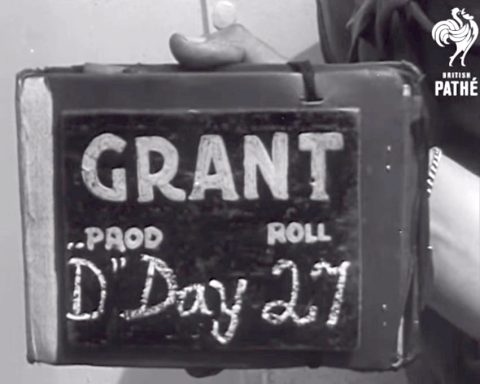
“British Pathé has some raw footage by and of Canadian soldiers…I’ve got something really significant here. Footage mis-labeled as “US and Canadian Troops In Anzio (1944). It is in fact the 4th Canadian (Armoured) Division in Normandy starting on the afternoon of D-Day. Slate is marked “Grant”.”
Clicking on the play button will start the video at the 5:14 mark, where we find Sgt. Bill Grant, and Lt. Frank Dubervill…
The rigid posture of England training is completely gone. Their uniforms are rumpled, pockets are heavily stuffed with survival essentials, and collars are unbuttoned, perfectly capturing the physical toll of grinding through the Juno Beach defenses.
Both cameramen are wearing standard infantry helmets covered in coarse twine nets. The scrim and burlap garnish strips are completely matted down, wet, and frayed—most likely the result of wading through heavy surf and beach fog during the early morning landing.
As Lt. Dubervill leans over the jeep to enjoy a hard-earned cigarette, his left shoulder clearly displays the unique blue and white embroidered “Canadian Army Film & Photo Unit” title flash.
At some point on landing, the pair would have met up and, possibly with a driver, used a Willys transport jeep which they pose with here to sort their gear, and…cigarettes. A heavy, dark-painted tactical storage trunk is bolted to the back; a safe hiding place for their camera gear and film rolls as they drove to safer ground.
One of the most famous stories of the CFPU on D-Day is Sgt. Bill Grant wading ashore, getting drenched, and immediately stripping his camera to save the footage (D-Day Discoveries video link: 8:44). He placed the exposed 35mm reels into a waterproof pouch, handed it to a random wounded officer heading back to an English hospital, and begged him to call the number on the bag (D-Day Discoveries video link: 8:56). The gamble worked, and his footage beat all other Allied film to the world newsreels (D-Day Discoveries video link: 9:06).
The Waterproof Wrapping: Wrap the canisters securely inside a British-issue vulcanized rubberized canvas utility pouch or a heavy-duty oilskin bag tied off tightly with cordage to protect the emulsion from saltwater damage (D-Day Discoveries video link: 8:50).
The “Dope Sheet” Tag: Securely attach a heavy-cardstock shipping tag to the exterior wire or twine. As seen in unit records, this tag should have “CANADIAN FILM & PHOTO UNIT – EXPOSED FILM” stamped boldly across the top (D-Day Discoveries video link: 5:05).
The urgent return instructions would have read: “URGENT DELIVERY: Canadian Military Headquarters (C.M.H.Q.) Public Relations, London. Phone: [Merton 2020]. Dispatched by Sgt. W. Grant.” (D-Day Discoveries video link: 6:03)
To correctly mark a Canadian Film and Photo Unit (CFPU) jeep for a Normandy campaign impression, look no further than the scale model showcase featured below. This display offers a crisp, close-up look at how historical markings, uniforms, and gear fit together contextually, mirroring the setup of frontline press configurations like the famous Canadian “Tank Bomb” vehicle.
Model Assembly & Paint: Meticulously assembled and painted by Colin Sibilleau.
Base Figure Sets: Sourced from the Bronco Models W.W.II British & Commonwealth War Correspondent Set.
Scenery & Vehicles: Additional vehicles, tanks, and structural diorama elements were custom-sourced and built by the modeler to bring the historic scene to life.
The Arm Of Service (AOS) Flash: The CFPU operated under the First Canadian Army Public Relations banner. The rear and front bumper should feature a square tactical flash divided horizontally: Cobalt Blue over Dark Red.
The Unit Code Number: Stenciled in crisp white over the blue/red AOS flash is the specific number “1214”, which designates the Army Public Relations and Field Photographic sections.
The Formation Sign: The vehicle must carry the First Canadian Army insignia—a horizontal oblong flash featuring a gold maple leaf centered on a red-blue-red tri-stripe background.
Bridge Classification Ring: Placed prominently on the front fender or grill, a yellow circle stenciled with a “5” indicates the light weight class of the Willys utility jeep for crossing tactical bridges.
One item I almost forgot to include is the camera case that houses the 35mm Eyemo.
Worth reviewing are additional posts listed below from some of the visitors to this website who were gracious in sharing their work in honouring the Canadian Army Film & Photo Unit via their dioramas, and re-enactments…
© Copyright Dale Gervais OCTOBER 2026