
AUTHOR’S NOTE:
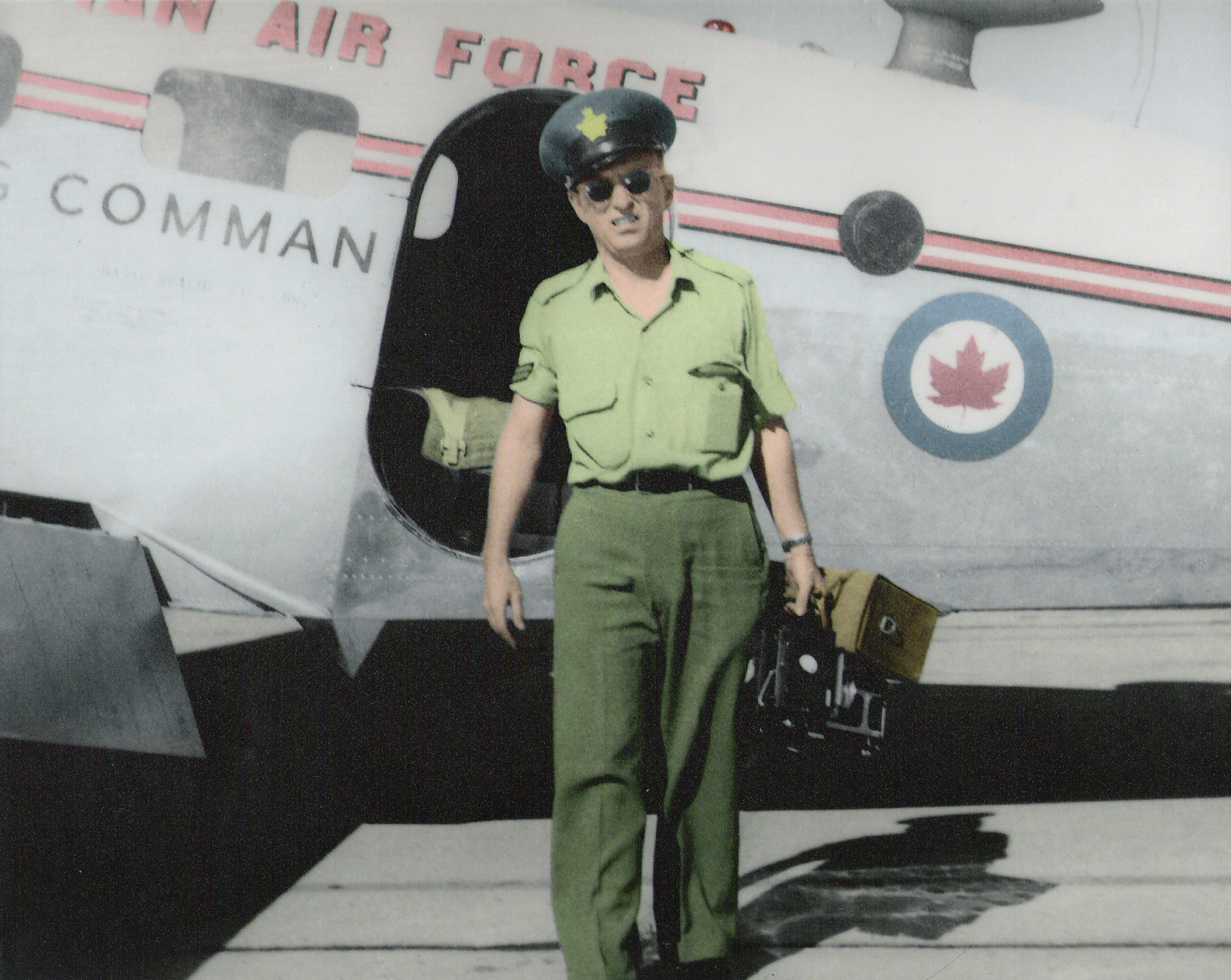
I first made contact with Ted Picard in 2009 via his colleague, Randy Pierce, while I was working at Library & Archives Canada. Even though this website’s main focus is to honour and share the stories of the Canadian Army Film & Photo Unit (CFPU), I knew how crucial it was to connect with other photographic veterans who served during WWII and Korea. My goal has always been to secure their special place in times of conflict and beyond, ensuring that their names live on.
Having spoken to Ted only briefly by phone back then, I was incredibly surprised to receive a large envelope in the mail (postmarked from his home in Summerside, PEI) containing his personal account—published here for the first time. Unfortunately, this piece, along with many other emails and pictures from ‘Mil Photo’ (Military Photographer) veterans, sat in a large binder in my office for years while I was focused on populating the CFPU website—dedicated to the profiles of the military photographers and teams who recorded Canadians overseas so that their sacrifices are never forgotten.
Every single one of these men and women needs to be remembered. A special thank you goes to Micah, who reached out to me through this website wishing to learn more about his grandfather.
Dale Gervais 2026
To all my children– Whom I love dearly. Ted Picard.
Some time ago my oldest girl talked me into writing some of the stories that I had told her about my life as a photographer in the service, as my kids 6, along with all my grandchildren 11, and great grand children 9, and great great grandchildren 2, would love to know what their parents did for a living.
Although there certainly is nothing famous about what I have done, there might be some stories which might be of some interest to you.
I hope you and your children enjoy reading these stories as much as I enjoy telling them.
Now, where do I start? …..
-The Early Years-
Well, guess I should start with my first camera, which cost me, I believe all of 75 cents. It was called a NORTON, and it took a size 127 film. By the way I was all of 12 or 13 years old at the time. I do not recall the price of the film, perhaps 15 or 20 cents. When I took the film to the drug store, where I bought the camera, the pharmacist, also the owner of the store, suggested that I should buy a developing kit, and do my own developing as it would save me money. Well, how much would this kit cost me? Around $10 or $12, he said. I left the film anyway, and when I got home, I convinced my Dad that this was what I wanted to do, and as I had some money in the bank, over time I would really be ahead of the expense. As you might have guessed, I got my developing kit. Ha! Now I was really anxious to develop my next roll of film. For a darkroom, I used the walk in closet in the bedroom which I shared with three other brothers. Don’t think this wasn’t a problem. However, as long as I kept it clean, they would go along.
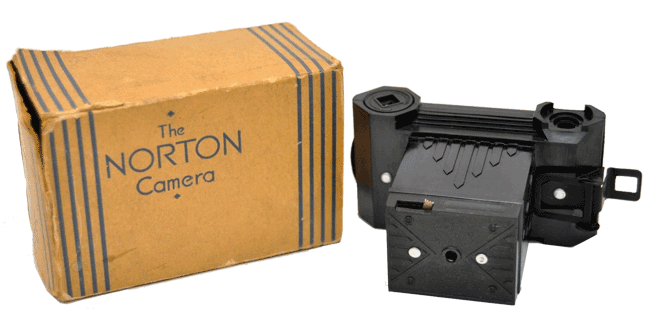
Norton Camera. Photo courtesy, Historic Camera.com (https://www.historiccamera.com/cgi-bin/librarium2/pm.cgi?action=app_display&app=datasheet&app_id=3184)
After reading the instructions carefully, I mixed the chemicals as directed, and then with my little red bulb sitting on the floor, I carefully separated the film from the paper backing, and dipped it into the developer for the required time, carefully rolling the film back and forth. Then into the fixer, at which time I was able to open the door to see what I had done. Low and behold, I saw my first wet negative. I was so thrilled, that I could hardly wait for the film to get washed and dried. Piece of cake I thought, nothing to this business, but as it was getting late in the afternoon, I had to put away my trays etc., leaving the closet clean.
Next day was Sunday; off to church, but I don’t think it did me any good, because I was only thinking of how I would print these negatives. This time only having read half the instructions, I rushed into the closet, closed the door, put one of the negatives into the printing frame, took the printing paper in with the negative as it said, and exposed it to white light, the approximate time was for me to determine. I carefully opened the printing frame, took out the printing paper, and quickly took the printing paper out of the darkroom to see my result! Ha, nothing, what happened? Back to the directions. Oh, it has to go through all those liquids again. How stupid can one be??? Well this was the start of what was to become my life’s work.
I was not much of a student at school. Seems I fought for last place on the report card, year after year. Until, at the end of Grade 9, my teacher said that I should find a job; this might be the best thing for me. Oh, how I hated school. So came the summer holidays, someone suggested that I should try the T. Eaton Co. Photo Dept. To my surprise I was hired. But it was not developing pictures, only acting as a bus boy. As the six or seven girls worked on the printers, and then developed their prints, it was my job to gather all the prints and put them through a fixing bath, then the washer, and then place them onto the dryer. Very boring job. However I put up with this for about four months. By the way, wages were great; $10.00 a week, of which I had to give Mom $5.00 for board. Amazing, how far $5.00 would go. I even had enough money to buy a brand new bicycle. It was a CCM double bar, double handle bar and balloon tires. It was the Cadillac of the times. It cost all of $55.00. But heck, look at all the streetcar fare I was going to save; 10 cents a day. And I only had 11 miles to ride to and from work. Needless to say my mother was not too pleased with me.
After my initial four months at Eatons, I applied for a job at Winnipeg Photo. The owner of the business invited me to come into the darkroom where he was printing the negatives; said he was too busy to talk to me outside. My first thought was, that this darkroom was so small and dirty. Dirty because the floor was wet with developing solutions etc. No way did I think I could work here. Well I got my eyes opened. This man was printing so fast I knew that he could do more rolls of film in less time than 10 girls doing the same thing at Eaton’s. As he spoke to me I’m not sure just what he said, because I could not believe my eyes, and my only thought was, if I could print like him I’d take the job regardless of the conditions. So to make a long story short I was hired. This was a mail order business, where people mailed in their roll of film; included with the film was a .25 coin, and for this quarter, they had a choice of either getting two prints off each negative, or one print plus one 5×7 enlargement, and the enlargement was of our choice. Then we had to mail the finished product back to the customer. (No wonder we were so busy.) Monday and Tuesday the mail man would drop off 5 or 6 big mail bags full of films. I can remember times when there would be maybe 20 or 30 bags waiting to be opened.
My first duties here were to make the enlargements; Lou Cohen, the boss would make the prints, and at the same time sort the negative that he thought would make the best picture. I soon became so efficient at this job, that I had to wait for him on the printer. Another thing that I thought was so remarkable, was the fact that he could make one test print and then go ahead and perhaps expose 7 or 8 rolls , (from 8 to 16 prints per roll), before he would put these through the solutions. He used a tray, 16 X 20 inches, and have anywhere from 40 to 50 prints being developed at the same time. This may not mean too much to you, but to get back to Eatons, one girl would test the first print of each roll and then develop the remaining 7 prints before going on to the next roll.
So the boss said “Ted, it’s time you start on the printer”. Well I started like the girls at Eatons, but Lou would have no part of this. He insisted that I do the same as he does, but start with perhaps 2 or 3 rolls exposed before developing. You know what? Within three weeks I was printing just as fast as Lou was. I can remember times when we would be so far behind with orders that Lou would challenge me to see who could do the most in a day, with the least number of make overs, (prints that were not perfect and had to be remade). He would beat me most times, but in a 12 hour day we would each do up to 120 to 150 rolls. I tell you that it kept Lawrence, who had to take the prints from us to the washer and dryer some busy. There was another person to sort and complete the order.
-Joining the Air Force-
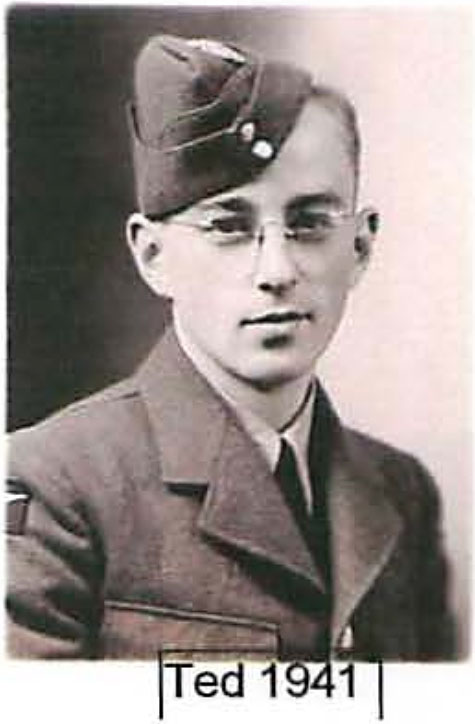
Now, there was a war going on at this time, and my brother Leo’s brother in law was in the Air Force at the time and he suggested that I should enlist in the RCAF as a photographer, before I would be conscripted into the army. This was the best advice anyone gave me.
As I was just a little fellow and underweight, (115 lbs), the Service was not about to take me. After several tries, I finally convinced the Doctor that I was small boned and, if I had regular meals etc., I would probably put on the weight they expected. So this was the start of my service carrier.
Photo courtesy Ted Picard
I was then sent to Brandon, Manitoba for my basic training, but because of heavy rains our tents ended up in the middle of a lake; we were all sent home for two weeks. At the end of this period, I was sent to Lethbridge, Alberta, to await my Photo course. There I was misemployed and referred to the Mess Hall (kitchen). For approximately 8 weeks I was on odd jobs and served the airmen from the steam tables. One incident that stands out when on this job that I’ll never forget; when asked to stir up the large Dixie of Tapioca pudding using a large long handle spoon, I began to stir up said pudding, when one of the cooks hollered at me to stick my hand into it and squeeze the tapioca through my fingers,. From that day on I was never able to devour the stuff. Finally, I was sent on my photo course in Ottawa Ont., which took about three months.
Photo courtesy Ted Picard
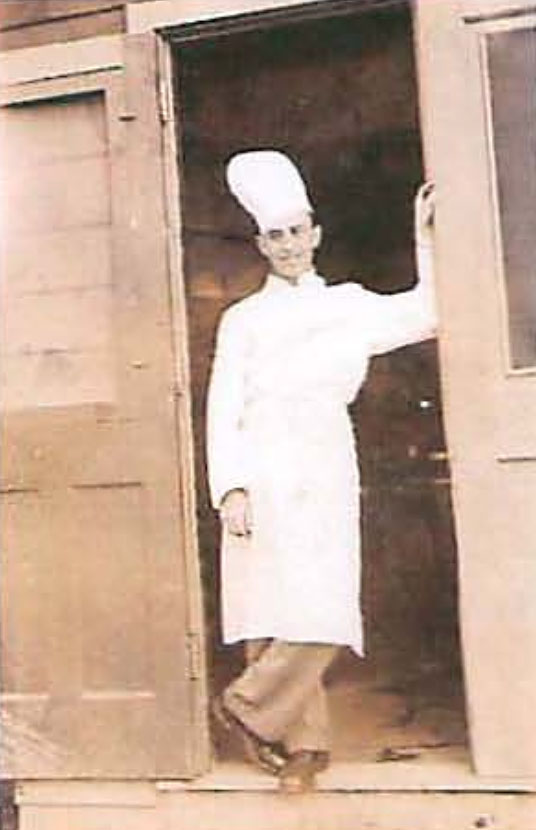
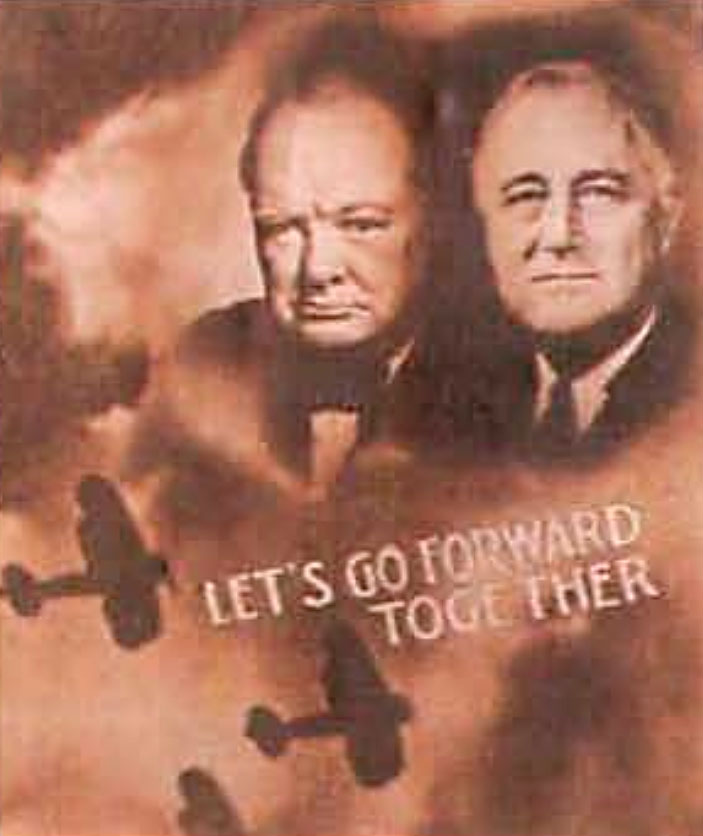
At the end of the course, one of the students thought that it would be a good idea if we held our Graduation party in Ogdensburg, New York, just across the border south of Ottawa. He then wrote to the Chamber of Commerce and asked if arrangement could be made to hold our party there. Their reply was overwhelming. They indicated that we would be more than welcome and they would put up the banquet and have enough girls to be able to hold a dance with. Also anyone who would like to be put up for the night in private homes. I for one, requested the private home and was introduced to a well known gentleman, Allan Newell, who requested that I sign his guest book. After signing the book, he asked if I noticed the signature above mine? Looking down at it I said it almost looks like President Rosevelt? That’s who it is and that’s the same pen that the president used to sign the book. I said “What an honor” and he replied that the honor was all his.
“This photo is a copy of the front page of our menu card and depicts Prime Minister Churchill and President Roosevelt“, photo courtesy, Ted Picard
Following the graduation, I was transferred to Dafoe, Sask., to a Bombing and Gunnery School, as assistant photographer. Duties there were to set up proper cameras on the aircraft to record the training results of the air crew. From there I was transferred to Gimli, Manitoba, a pilot training school where I was required to set up a new photo lab, and to prepare and give instructions to pilot trainees on the requirements of piloting bomber aircraft over targets, so that the bomb aimers could do their job properly. Also to give instructions on the use of the cameras and their importance to analyze the target results.
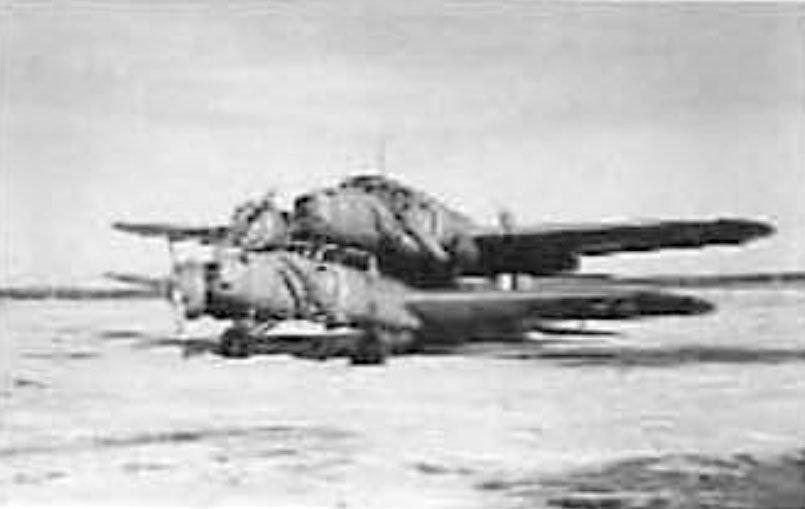
Two unusual accidents involving Anson aircraft both landing at the same time and neither pilot knowing of the other aircraft making perfect landings, except that the top pilot could not understand why he was so high off the ground till they came to a stop. Now, there were three such accidents and I was at the Base for two, while the third one took place in Australia. Photo courtesy, Ted Picard.
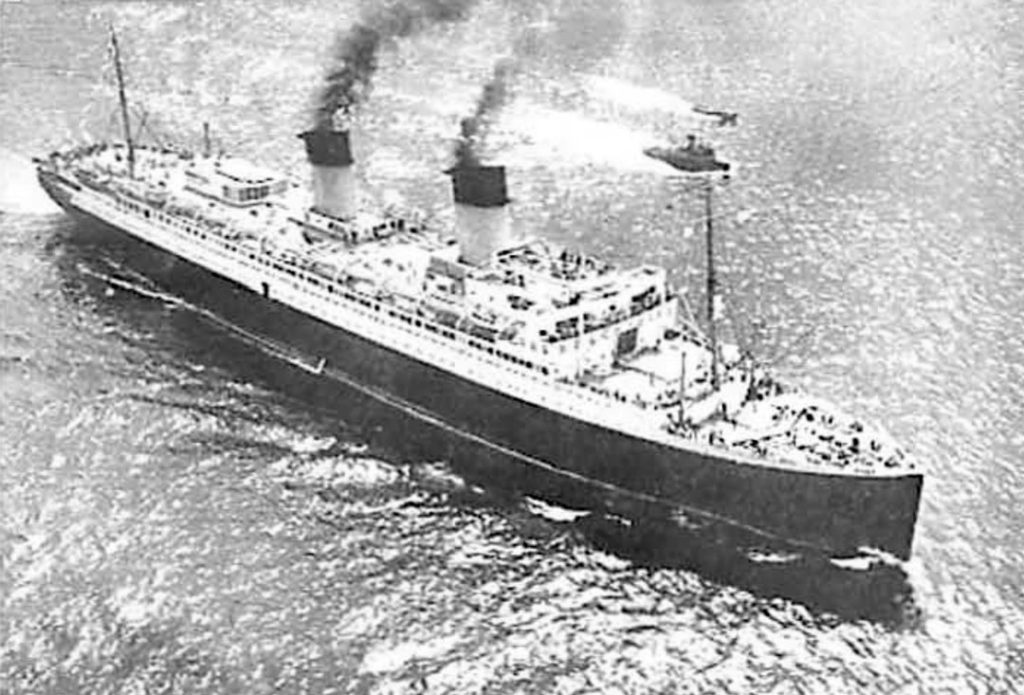
Late in 1942, I was transferred overseas. We sailed across the Atlantic in a cruise ship named “L’Île De France”, however it was not fancy like the ship was built, as all the interior partitions had been removed and hammocks were installed 4 deep; one above the other and, the ceilings on these ships were only 6 ft high, so you can imagme we were pretty tight. The only place on the ship that had not been changed was the chapel, and this was beautiful. This gave us an idea of what the ship really looked like prior to being converted to a troop ship. It took seven days to cross as we had to zig zag all the way to avoid German submarines.
Photo courtesy, Ted Picard.
We landed somewhere in Scotland and transferred to trains, which took us to #6 Group Bomber Command and to a place called Tolethorpe, in Yorkshire, England, where two bomber squadrons were stationed; 420 and 425 squadrons. The latter being a French-Canadian Sqdn was named the Alouette Sqdn. There we equipped the Lancaster airplanes with the F24 camera and just before these Sqdns took off on a bombing mission, we had to set the cameras for the name of the target, height, and direction the a/c would be flying at the time they dropped their bombs. On their return, we had to attend debriefing of the crew to get any deviation from original orders, and reports of amount of flack they received over target. (Some of these reports were very scary.)
As aircraft returned, we would have to retrieve the film from the planes and take them to the lab for processing. On one instance, I had noticed that this particular aircraft did not take off for the mission as I could see the full bomb load still intact. As I exited the plane, returning to my jeep, I saw the crash truck heading my way, as one of the returning planes had been badly damaged while over the target. I was perhaps a hundred yards away when I heard the damaged a/c skidding off the runway. Looking back, I saw the troubled plane heading straight for the parked a/c with the full bomb load. As they collided, the bombs began to explode, knocking me to the ground.
Photo courtesy, Ted Picard.
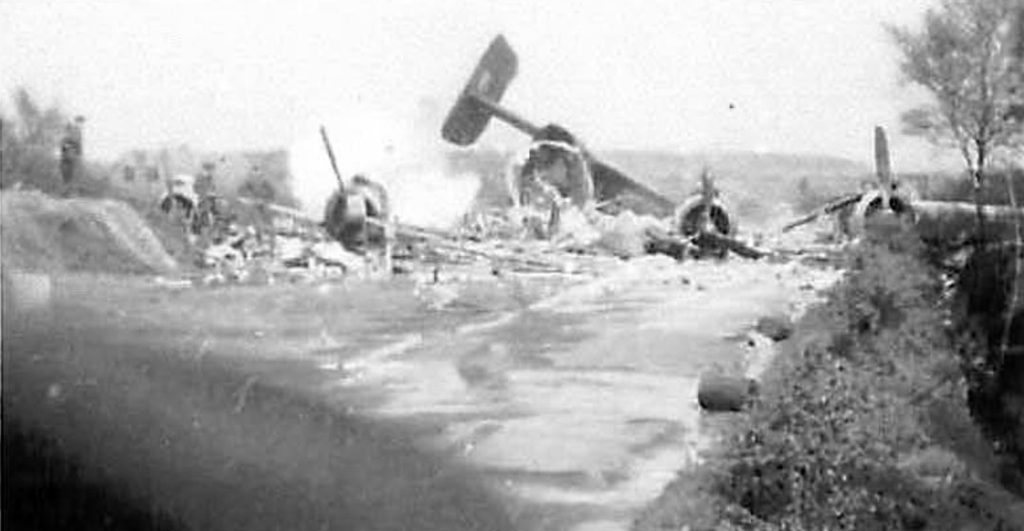
The crash crew (God bless them) along with the Squadron Commander ran to the aid of the flyers; some to help the trapped pilot while the Commander went to the aid of the tail gunner with an axe to cut him loose. There was another explosion, this time the Commander had one hand badly damaged, later the doctor had to amputate close to his elbow. His name was S/L Orr. I cannot remember the others.
Cameras had to be unloaded: the film, developed and five prints made of each negative in a rush to get them to Headquarters to be analyzed, to confirm the target was hit, and just how much damage was done.
In 1945 the war ended with Germany. We were instructed to pack our photo equipment in readiness for shipping to take up with the war in Japan. We were then given 30 days leave and transportation home. It was wonderful to see all the family again.
At the end of this leave, I had to report to a holding base in Nova Scotia called, Debert. We were only there about 10 days when the Atom Bomb was dropped, which quickly ended that war. All our photo gang were soon released and sent home. But not Ted, he was selected to unpack and tag all the photo equipment for return to unit supply section, which took several weeks. However, I was soon on my way home.
– Flin Flon-
Home, now looking for work. It wasn’t long before I received a call from a gentleman in Flin Flon, Manitoba, who was looking for a photographer to run a portrait studio there. I jumped at this offer, as this was what I had hoped to be able to do. He was the manager at the local radio station and we met at the train and he took me straight to the studio, and asked when I would be ready to prove my ability. He had already lined up a couple of girls to have their portraits taken. I requested a couple days to give me a chance to prepare my solutions and acquaint myself with the equipment.
He brought in two lovely looking girls, which made my job quite easy. Needles to say he was very pleased with the results. So that was the start of my post war career. But this only lasted a couple years. But, I am getting ahead of myself; this is where I met Luella. Why she ever put up with me, I’ll never know. If we went for coffee she always paid for her own, etc. We spent a lot of time at Phantom Lake. One particular October night a bunch of us went swimming about 10 PM; the water temperature must have been around 35F because I hit the water and was out just about as fast as I went in. We then went for a walk and this is were we fell in love; for our song “Begin The Begin” by Cole Porter.
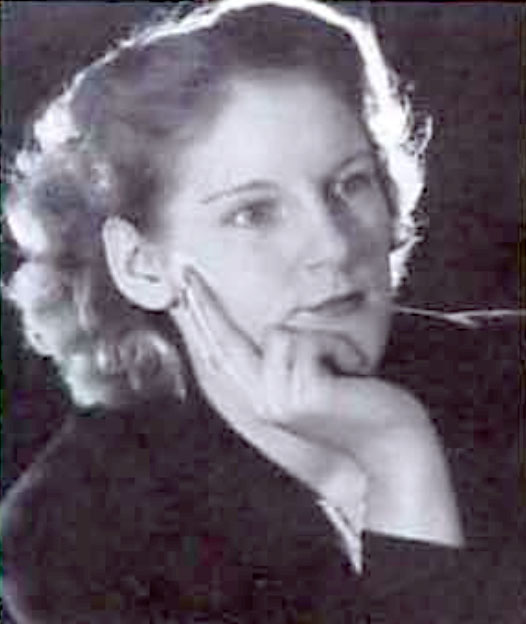
November took us to Winnipeg to meet my Mom & Dad and what family was around. Returning to Flin-Flon the next step was to set a date for our wedding. Why we picked the first day of February is still a mystery. However, both of Luella’s sisters Helen and Estella, offered to help make all the arrangements. Meanwhile, Luella was busy taking instruction from Father Malloy for conversion to the Catholic Faith and preparing for Baptism.
Photo courtesy, Ted Picard
Our wedding went off without any hitches, and my roommate Woody, who was the technician for the radio station, brought in a recording machine and recorded our ceremony on 78 rpm vinyl record.
For our first home, in the summer of 1947 we, along with Luella’s sisters, purchased a plot of land and began to build our own houses. First of all we borrowed a tent to live in. As it was already late summer we needed some way to heat the tent, as we slept there every night. So we purchased the oil burner to be used to heat our new house when completed. Also a pot belly wood stove, which was set up outside for cooking our meals on; just about everything that we ate was cooked in a pressure cooker. And if you can picture Luella eight months pregnant standing on a scaffold trying to hammer nails on the siding, a picture that would be worth a thousand words today.
November 23 was also a night to remember; we had just moved our bed into the new home, as it was now weather proof. We awoke in the morning only to discover that we had a heavy snowfall through the night and looking out at the tent saw the roof had pretty well caved in. We both kind of laughed and said how fortunate we were.
As Luella was getting close to birthing, the Dr suggested that perhaps she should move closer to town to be on the safe side. So, the next morning I took her in to see the doctor; he thought that perhaps she had better just move into the hospital because it looked like the baby could come soon, at which time I told him that it was my birthday tomorrow and wouldn’t that be great. This was at 11 am. Shortly after 12 noon the hospital called to say I was the father of a baby boy. This was Nov. 25, 1947, and he was named, Garnet Arthur.
At this time I discovered the owner of the other photo studio, was also the owner of the one I was operating and he did not like the competition. We got into a heated argument, and naturally I lost. This ended my studio work.
Now the fun began. What was I going to do? As I had started to build my own house, was in debt, and God knows what else. However, a local contractor was looking for a plaster’s helper; I applied and, the next morning I wondered if this could be the start of a new carreer. I quickly discovered it would not. First he showed me how to mix the mortar, then he filled two pails, carried them to his work bench, told me to take the pails back, but cautioned me not to fill them too full. I returned to the mortar pile, and with the hoe I proceeded to fill the pails, to only half fill them did not look right so put in a couple more hoe fulls. Then I bent down to pick up the pails, but to my surprise they were stuck to the ground, no way could I lift them. Now using the hoe I’m trying to dig out of the pails, wondering all along if he was watching and laughing at me? Now, as you have guessed, I did not stay very long at this job; as a matter of fact, only till noon.
Well the following day, I got another dandy job. This time found me shovelling coal out of a box car. No, this was not meant for me either. Back to the beer parlor. Oh great, another good job, this time I was to be a helper to the ice delivery man. Oh boy, and I thought that the mortar was heavy! But the iceman said in just a day or two, I would get used to it, and it would get easier as time went on. The next morning I was unable to bend over to put my shoes on.
Well during this same time my father was not well, and a letter from home said he would not last the winter. I could not afford the train fare to Winnipeg to go see him, so I came up with another brilliant idea. Remember back 1940 I had applied for the Air Force? And they would not take me because I was underweight? Well this is 1948, the war is over and I said to Luella, I think that I will apply to join the Air Force. They will have to send me to Winnipeg for a medical, as I am still under weight, only 116 lbs and now in peace time there is no way they will take me. They will have to send me back. But while there I will get to see my Dad. So, 1948 of to Winnipeg I go. Visit with my parents, then went for my medical. To my surprise, the Dr said if my X rays were clean, I would be accepted. Now I had to make a quick decision; I had to call Luella and get her thoughts on this. She said it was up to me, and what ever I decided would be OK with her. That’s how I came to make the service my career.
-Winnipeg and Montreal-
I spent the next two years, as a photographer with 402 Reserve Sqdn in Winnipeg. Then June 18, 1949, we were blessed with a beautiful baby girl, who we named Cheryl Ann.
Nothing too exciting except for the big flood, (1952) at which time Luella along with two children, had to be evacuated from our home, on Humboldt St. St., Vital. So off to Flin Flon (500 miles North) they went to live with Luella’s sister. The high waters completely filled our basement to within 1 inch of the ceiling. It was a terrible mess to clean up. We were at the time burning coal in our furnace. You can guess the mess that the coal made?
The following year, I was posted to Montreal. Our first accommodation was an upstairs two bedroom place with a balcony overlooking the street. On the adjoining balcony lived a five year old boy, approximately the same age as our Gary. Although he could not speak a word of English, and of course Gary had no French, the two boys got along very well. You would never know that neither could understand the other.
Well now, Judith Lynn (Judy), came along 23 September 1951, so we had to find a little bigger place to live. Our next apartment was a basement apartment in the middle of a Jewish district. Upstairs on our left lived a Rabbi and his wife, who seemed to always be making too much desert, or cake etc., and she would often bring it down for us. Guess that I never told you just how poor we were at this time. There were days we were not sure what we might have for dinner. So were very thankful for our neighbours. Another couple in the building would have a fit if ever we put Judy outside to sleep after her noon bottle without one of us sitting out to watch over her, for fear some one would come and steal her. So they would mind her for hours. About this time my brother Leo, and Ruth were transferred to Montreal too. This was great, as we now had family nearby to visit and Ruth would always bring a loaf of bread or cake to leave with us.
I just had to find some other employment on my off hours, to supplement my service pay. So I went to the local theater to see if I might find work as a projectionist. I couldn’t have picked a better place, as the projectionist there, Jack Kember, was a real prince (guess the good Lord was looking after me). He invited me to come and get acquainted with his booth.
Perhaps here I should explain the workings in a projection booth. Movies normally came in anywhere from three to six or seven reels, depending on the length of the show. Each reel ran through the projector at 25 frames per second and took about seventeen minutes.
There were two projectors in the booth, while one was in operation, the operator would be rewinding the reel that had just finished from the other projector, and loading the next reel to be ready for the change over from one to the other, which the operator would get his signal on the screen (the audience was never aware of this signal). Now Jack would get this work done in less than three minutes, then would curl up in a comer, and fall fast asleep, and only wake a minute or so before the change over was to be done. I can remember coming in to relieve him and finding him asleep and I was sure that he would miss the action. To my knowledge he never did.
Photo courtesy, Ted Picard.
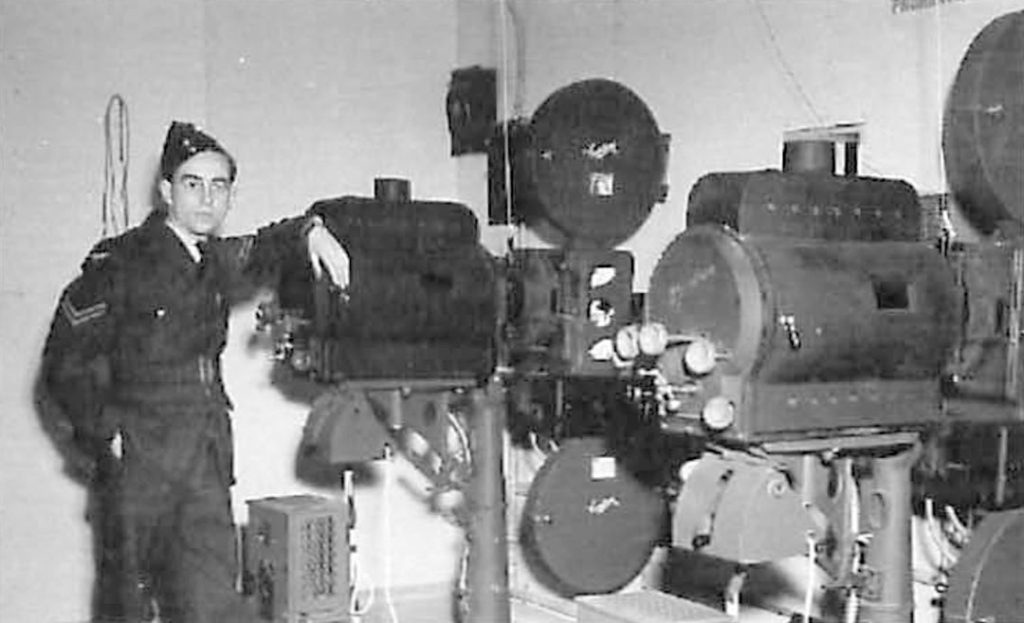
At that time I worked from about 5pm till the movie was over, normally to 11-11:30 for all of $5.00 for the evening. Even so it helped to put extra bread on the table. Jack soon was given the operators job at Montreal’s newest theater, where I visited him on many occasions. One day he asked me to relieve him one night. As I was not supposed to be able to work at this fine theater he paid me from his own pocket so that the Union president would not know. Jack had some kind of business on the side and was afraid he might loose this job if he asked for too much time off. I agreed, took over his shift and wouldn’t you know, about 8 PM in walks the President; I had to think fast. So I jumped at him and asked where had he been all evening, that Jack had taken ill, tried to call him and also could not find the regular operator, and called me in to stand by just in case he would need some help. I told the president that Jack was so ill, that I sent him home. The president then apologized for not being available and thanked me very much for coming to his rescue. He then stood by to watch me operate the rest of the movie. There is nothing I hate more than someone looking over my shoulder, he made me nervous, but I managed OK.
Also at this time I was transferred to St. Hubert, now working at my trade as a photographer. Soon I was assigned a PMQ (apartment) on the base. This helped as the rent was more reasonable. I had a lab to work in, so now looked for odd jobs pertaining to my trade. Started by doing Wedding photos, and soon this got to be a regular Saturday occupation.
Good old Jack Kember, kept finding me odd jobs. This time, knowing that I was a photographer, he lined me up to do a job for a wrought iron company to photograph wrought iron furniture, and supply 8 x 10 prints in an album for their sales persons to show their clients. Great, this helped, but now I needed a car to get around to all these jobs. I was soon a proud owner of a used Hillman sedan.
The next job he got me was to photograph lingerie on live models. Wow, this was new work for me. But the client wanted some samples of my work. This was going to be a problem. So I mentioned this to one of my friends, with the result being, that his girl friend had a nice figure, and he was sure that she would cooperate. The pictures were to taken at our house. Well, Luella, I and the girl ended up having many laughs. But in the end the pictures turned out quite well and the client also was pleased. Said that he would get back to me. About a week later, Jack called to say that this client had found the artist that could draw the clothes, as he did this for the T. Eaton Co and could draw them at a lesser price.
About this time I had an internal transfer to Air Defense Command Headquarters, (1953) as a Public Relations (PR) photographer. Which meant that I would be doing photo stories of service people at their work, for release to their home town news papers. So I did a lot of traveling, mostly to radar sites, which usually consisted of technicians sitting in front of a radar screen. This was top secret stuff at this time, so there was quite a demand by the news papers for this type of publicity. One of these radar units was at Three Rivers PQ. There were many interesting stories, so many, that I extended my stay there for three days instead of the usual one. The greatest of these was a picturesque view of the radar towers overlooking a small man-made lake in the center of the base.
I got permission to release this photo and story to CP (Canadian Press) which was forwarded to all the daily newspapers across Canada. British Columbia felt that they were being left out of this line of publicity, and wanted permission from Air Defense Command to be able to visit and get photo stories for themselves. Permission was granted, with one exception; No cameras would be allowed, but a photographer would be supplied from Defense Headquarters. I was sent from Montreal to Comox, B.C., as I was cleared top secret and knew what could be photographed and what could not.
On my arrival at the unit, I reported to the local PR officer, explaining my duties there. Well, all hell broke loose and I was led into the Commanders office, to be told that I would not be allowed to take my cameras into the radar building on any account. My only reprieve was to have him call Air Defense HQ to confirm my security. He was still hesitant, so ordered the officer to not let me out ofhis sight for one moment. As it turned out, I was only requested to take two pictures for the BC news papers These turned out to be the most expensive photographs that I have ever taken.
In 1956 another very interesting assignment came in from Ottawa by Ministerial telegram. When one ofthese messages come in, they mean business. The whole base was alerted to get me outfitted with northern clothing, a travel claim with a $ 100 advance and to be in Ottawa within a couple of hours. I never in my life ever moved so fast. I was flown to Ottawa in a jet a/c (T33- T Bird) with all my equipment. I was met in Ottawa by the head man in Public Relations; was told that I was to accompany the Canadian Minister of National Defense (Ralph Campney) ,and the USA Secretary of Defence (Charles Wilson) ,along with a couple of 5 Star Generals, on a trip they were making to inspect the Distant Early Warning radar sites. My boss insisted that I be sure to get a photo of the minister standing alongside of an Eskimo with an igloo in the back ground if at all possible.
For some reason I was assigned to fly on the American aircraft (whereas the others moved between air crafts. Well wouldn’t you know the aircraft I was flying in was Air Force One – the Columbine – used by President Eisenhower (whose wife’s hometown was named Columbine). The Aircraft was a stretch DC6. Never before or since have I flown in such class.
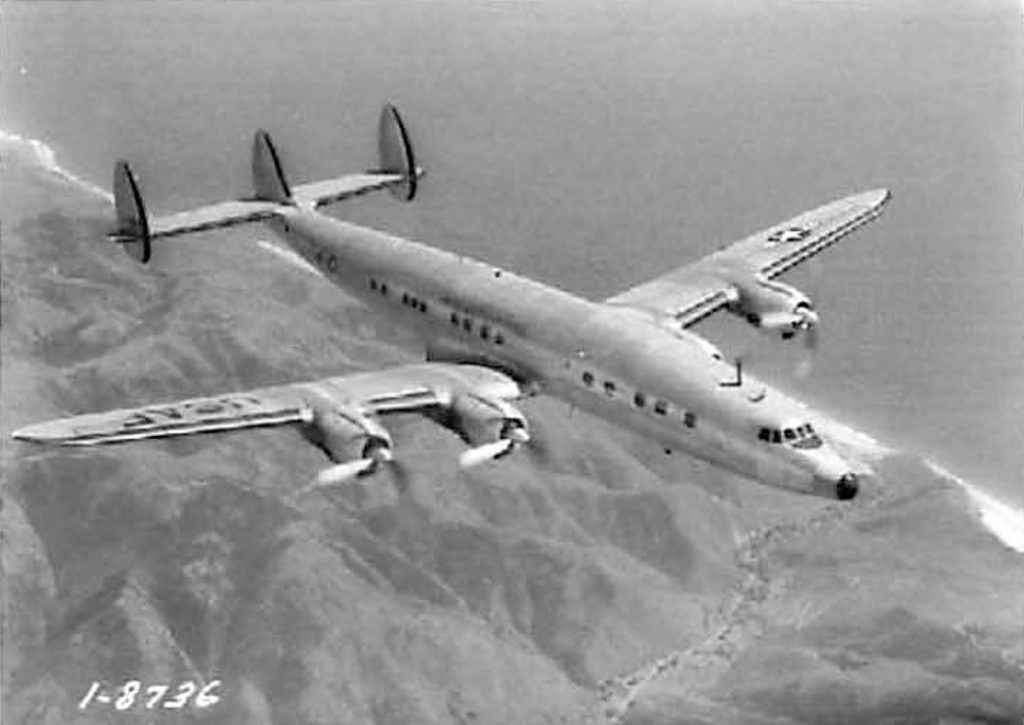
Shortly after we took off in Air Force 1, the Secretary of Defence approached me where I was sitting up front, put a log book on the table in front of me saying, “It is Customary for all passengers to sign this log book”, and he left. This I understood and quickly picked up the pen and signed my name. Awaiting his return to pick up the book I was glancing at the signatures above mine, and thought, I should never have signed this log. As the names were of great VIP’s like Kings and Queens, Ambassador’s and the like. So when he returned to pick up the book I told him that I did not think I should have signed this log. He replied that I was just as important in this airplane as any of those, and not to forget it. Also, should I required anything, not to hesitate for a moment, and to enjoy the trip.
Photo courtesy, Ted Picard.
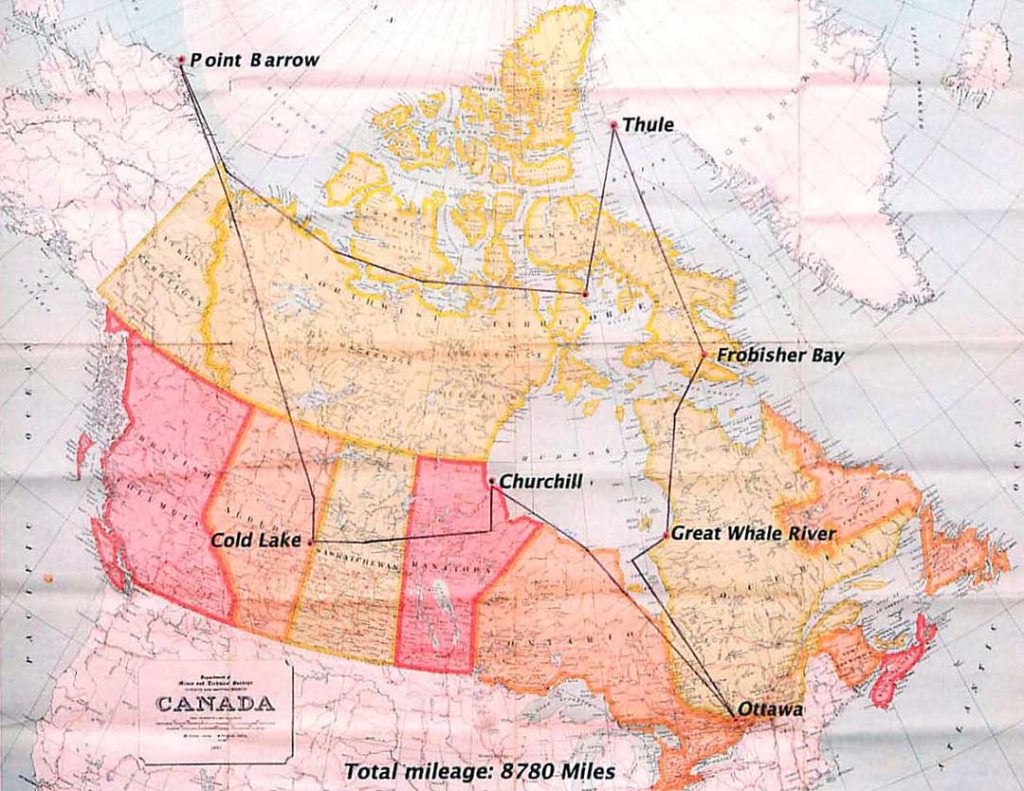
We flew to Great Wale River, with about one hour stop. Then on to Frobisher Bay, again about another one hour stop. On our approach to Thule, Greenland, we were greeted with four U.S. fighter planes by our sides. Thule was a US air base, where we spent the first night. I spent the evening with the a/c’s crew in the Sgts. mess. We were of course treated like royalty, and unable to buy anything, except that I did buy a carton of cigarettes. The next day we took off about 9 AM and flew west circuiting each of the radar bases between Thule, Greenland, and Point Barrow Alaska.
Just ahead of where I was seated was the galley. The steward, whose name was Ron, could have been the twin of Jack Jobin (my brother-in-law). Guess that I was staring at him, when he was pouring some liquor from one bottle to another, he smiled and held up one bottle and indicating that one bottle was for the VIP’s and the other he pointed to me and himself. We became instant friends. About 11 am he cooked hamburgers for every one, with at least a
¼ pound of meat in each.
After I had eaten mine, I went up to his galley to watch and talk. He said “There is only one way to enjoy a good hamburger”, taking the meat from the fridge and putting it directly into the bun with a little mustered. Not even warming the meat at all.
The scenery, as we flew over this northern tundra was very barren and cold looking, until we passed over the northern part of the Rocky Mountains; then the view was mind boggling. If you can picture the mountains in pure white, and without a blemish. And in late afternoon with the sun casting deep shadows into the ravines and crevasses it was just gorgeous.
We soon landed at Point Barrow ,Alaska. We were met by a tractor pulling a closed in shed, which was heated with a pot belly stove in the center with benches that lined the walls. It took about 10 minutes to reach the building where the Dining room was located. At this time I mentioned to the Minister ofNational Defense that I had been requested to be sure to get a picture of him (Mr. Campney) alongside of some Eskimo’s, and beside an igloo if at all possible. He consented and suggested we do this before we went any further. We managed to find a couple of Eskimo’s, but no igloo in sight. Following this we were directed to our billets, and of course as we were all dressed in northern gear, no one knew who was a VIP or not. So here I was a little corporal sharing a room with the head of the Armed Forces. It did not take me too long to see an empty room across the hall and away I went.
In the dining room, I got to talk to one of the cooks, who he claimed used to be a cook in a big hotel in New York; took this job because the money was so much better. He indicated that the workers up there were a bunch of hobos, but took advantage of everything. They were fed steaks every night, and to their liking, and if it was just slightly over done or under done they would refuse it. Claimed that when in the N.Y. restaurant, it was very seldom that a steak would be returned. The waste was really disgusting.
However, the next day we took off for Cold Lake, Alberta. Followed the next day with a stop in Churchill, Manitoba, then back to Ottawa, where I was met by a photo team waiting to process my work and forward it to CP., (Canadian Press). Copies of these photos were sent out to all daily newspapers across Canada.
Another interesting story took place in Montreal… Perhaps I should mention we supplied photographs to the local newspapers free of charge. So, a very early morning call said I was to report to the hangar with my camera, to go flying in a CF 100, to photograph the eclipse of the sun, as the weather on the ground was too cloudy for anyone from the newspaper to get pictures. So, there I am sitting in the rear cockpit of the CF 100, getting instructions from a technician as to how to eject in the case of an emergency. He was no help, as I was even scared before getting into the aircraft.
Photo courtesy, Ted Picard.
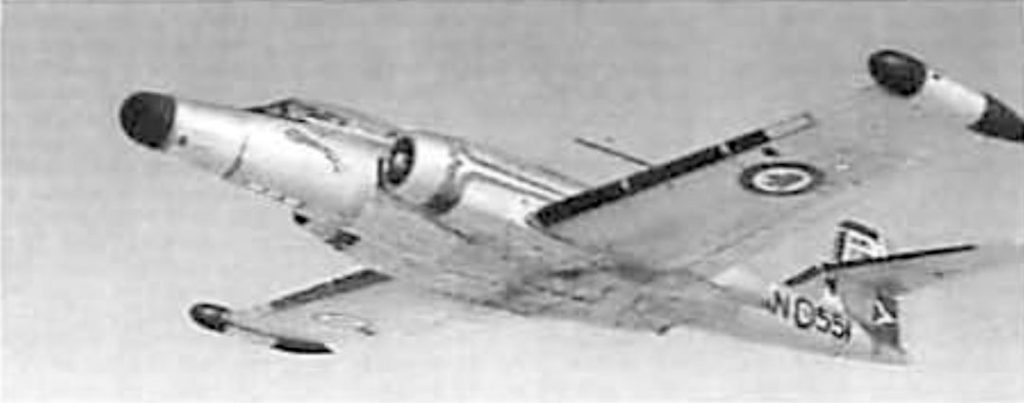
However, we took off, got over the cloud and flew back and forth over the city of Montreal,. During the run I was trying to get pictures of the eclipse. The job completed, the pilot asked me if I was it in a hurry to return to base? No, was my answer, so he said, let’s have a little fun. So off we go, doing a few maneuvers that the fighter pilot might do, and with the 10 pound camera sitting on my lap, with some of these sharp turns, and in one case he did a loop; the 10 pound camera turned out to be about 60 or 70 lb. One half hour later, I am back in my shop and physically fatigued. Never seen a sorting table look so good. I just laid down and had a little rest.
NOTE: On June 2nd, 1955, the birth of Richard Allan (Rick), came along to bring the family to four...
-British Columbia-
About a year later, I was transferred to Vancouver, # 5 Air Division, as the PR photographer, representing the west coast. Here I was involved in a lot of Search & Rescue flying. Either in a fixed wing or Helicopter aircraft. At the time, my office and home was in downtown Vancouver, and it was about a 15 mile trip by car to the airport, so that when I was called to go on a search, it would take me all of 15 to 20 minutes to get there. By this time the aircraft would have been ready for immediate take off. One of the longest searches involved an Air Canada, North Star, aircraft that disappeared with the Saskatchewan Rough Riders football team on board. We gave up on the search about 15 days later, as winter had set in and there would be no chance of survivors. In the spring of 1957, or 58, a couple of mountain climbers out on a Sunday afternoon climb, came across a small instrument, which they took into Air Canada, for identification, and from the serial number, it proved to be from the missing plane.
So, bright and early Monday morning I was instructed to drive to a base camp situated at the bottom of Mount Slessie. On my way there I was also requested to pick up a reporter from the Victoria TV Station. During our drive to the camp, he had seen and used some of my news items on their station and asked if I would be interested in taking charge of their photo department as full time employment. I told him that I would have to think about it, and queried him as to wages etc. He replied that as they were just a new TV station, he could not promise a great deal for a year or two. When he stated a figure which was about half of my service pay, I quickly informed him that this would be out of the question, with my wife and four children, even the service pay was very skimpy.
On reaching the base camp just a few miles north east of the Chilliwack Army base, we were met by a dozen or so reporters from all across Canada, all very interested in getting first hand photos of the crash site. It was a service custom that because of the number of persons wanting to fly in the helicopter, and also with the dangers of having a fatal crash, no civilians were allowed on board. They were all notified that I would supply prints to whoever requested them and at no charge. Now, an elderly man came over to me and introduced himself as a photographer from Paramount News. At that time news was still shown in the theatres before the movies. He asked if I could take his cameras on board and shoot a few feet for him, that it would help maintain his position with the firm for a couple more years. I said that if I took his camera, every other reporter would be asking the same. However, I said if he could sneak his camera on board without anyone noticing, I would try.
We flew around the crash site three times while I got stills and video. I then asked the pilot if he would take one more turn around, and with the 35mm camera, shot some footage for Paramount news – which presumably was the only footage to be shown in the Paramount Theatres in relation to this find. The pilot took me to the local airport where a small plane (Norseman), took me straight into Vancouver. On the way, I had radioed ahead to have a staff car meet me and take me to my photo lab in town. On the way in I dropped off the cine film to be processed. Then on my arrival at the lab, I picked up the phone to call Luella to say I was again back home. The telephone operator said that I had a call from Seattle, and that she would put me through. It turned out to be the television station saying that they heard I had video footage of the crash site and even found out who was doing my processing and requested a copy to be made for them, but that they needed my approval. This was arranged.
Another interesting story, that I think should be told, is the time that Search & Rescue got a request to lift a small aircraft off the mountain side on Vancouver Island that had crashed there some three or four months earlier, and could be seen from the highway, close to Victoria. For the reason, many motorist’s were stopping and walking up to the crash sight; the Federal agency was concerned that with the dry season in effect, some would be sure to start a fire when discarding cigarettes, etc.
I was called at 07:00 hrs to head to the airport with my camera equipment. I had no idea of just what the assignment would be till we arrived at Port Alberni, where the pilot let down and instructed the crew to unload anything on board that would not be needed for the rescue. The pilot also advised all of us that he would be going into the site with the minimum of fuel, so that we should not take any longer than absolute necessary, at the same time he indicated that after the aircraft was tethered to the helicopter he would lift off, and if he thought he had enough power to bring us (three crew and myself), back in, he would do so. During all this time I was desperately trying to get as many different angles as possible, and wearing only my regular oxfords on my feet, made everything that much more tedious. With one foot 5 to 6 inches higher than the other, because of the slant of the mountain side.
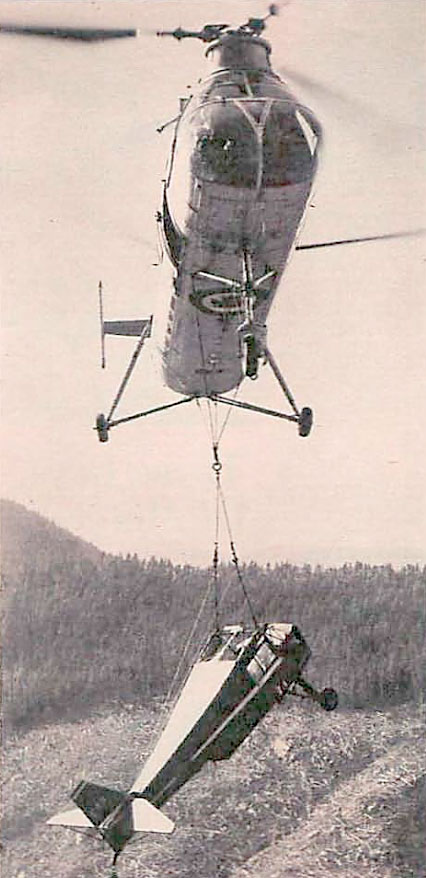
At this point, the pilot had tested for power and returned to pick us up. As I was the last to be pulled up to the chopper, I realized that I would require both hands to be able to properly attach the harness under my shoulders. I had to lay the camera down to do so, and looking for some place level enough to lay the camera on, I spotted a tree stump that had been sawed off about four feet to my right. Having done this and knowing that the pilot was in a great hurry I motioned to him that I was hooked up OK before moving back directly under the aircraft.
He then began to pull away from the mountain, leaving me now dangling 20 feet below the aircraft, but now 500 to a 1,000 feet from the ground. As the crewman on board began to hoist me up, I began to rotate, because I was not directly under the aircraft when I began my assent. I soon felt a sudden jerk on the line and wondered what that could have been. It was only after I got the second jerk, that I realized that it must be the strands on the cable that were breaking. At this point I held the camera tightly to my chest and looking up, I could see two of the crewmen looking down at me (I’m still 10-12 feet from the craft) when I got the third jolt. Surely I thought there cannot be many strands left, and would I make it?
“This photo was published in the Saturday evening post”, Photo courtesy, Ted Picard.
As my eyes came level with the floor, I threw my camera and grabbed hold of the floor to pull myself in with the help of the crew. I was so frightened that I had swallowed every bit of saliva in my mouth and was more or less choking trying to get my breath. When we landed in Port Alberni, I informed the crew that they had better examine the cable, and explaining what happened, they asked if I had ever been trained to descend by cable? Answering no, they then explained to me what was happening. As I had not positioned myself directly under the pulley, the aircraft pulled away from the mountain, and caused me to swing side to side under the aircraft. This movement caused the cable to make contact with the aircraft thus momentarily causing the pulley motor to stop and start, thereby the stretching effect of the cable. This is one of many scary incidents, during my tour in BC.
In 1958, I was transferred to Holberg on the very northern tip of Vancouver Island. This was a Distant Early Warning radar site. There was nothing too interesting here, work wise that is. But the base was truly an interesting place because of its smallness and remote situation.
The PM Q’s here were something to behold. They were three bedroom houses, with in-floor heating, and a clothes drier, along with carports. With an average rainfall of 300 days a year, the carports were needed as a place for the kids to be able to play outside.
Luella was in seventh heaven as there were so many unattached men stationed there, that on dance nights, she being such a good dancer, she was never sitting out many numbers. HA! It was time Ted learned how to jive. So between Lou and a Rec spec., and our living room, a record player and many, many hours to the tune of “Mac the Knife” I finally got the rhythm.
Here the base had great facilities for recreation. One being a regulation size swimming pool where Lou and Vic (base rec-spect) spent many hours coaching Cheryl in the pool. This also included high diving. Vic thought that Cheryl was good enough to compete in the west coast diving competition. So with some financial help from the base, we all flew to Vancouver, where Cheryl took first place in diving. I suppose I should add she was the only one participating in this category, but not to take anything away from her, as it took lot of guts just to be there.
Holberg no longer exists and the base has been reclaimed by the B.C. Trees.
-And now for…The Sixties-
From Holberg, I was posted to Saskatoon, Sask. Saskatoon was not only famous for its 5 bridges, but we increased the population by two more with Robert James (Bob) 28 Aug, 1960, and Brenda Joyce, 15 June, 1962. Saskatoon was a great little city, and a great place to bring up kids and we often thought that we would like to settle there when I retired.
Saskatoon was the home of the Red Knight T33 (jet aircraft) which put on some great air shows across the country. Here, I also did some more air to air photography. One request was a photo of the red knight flying over the city of bridges in Saskatoon.
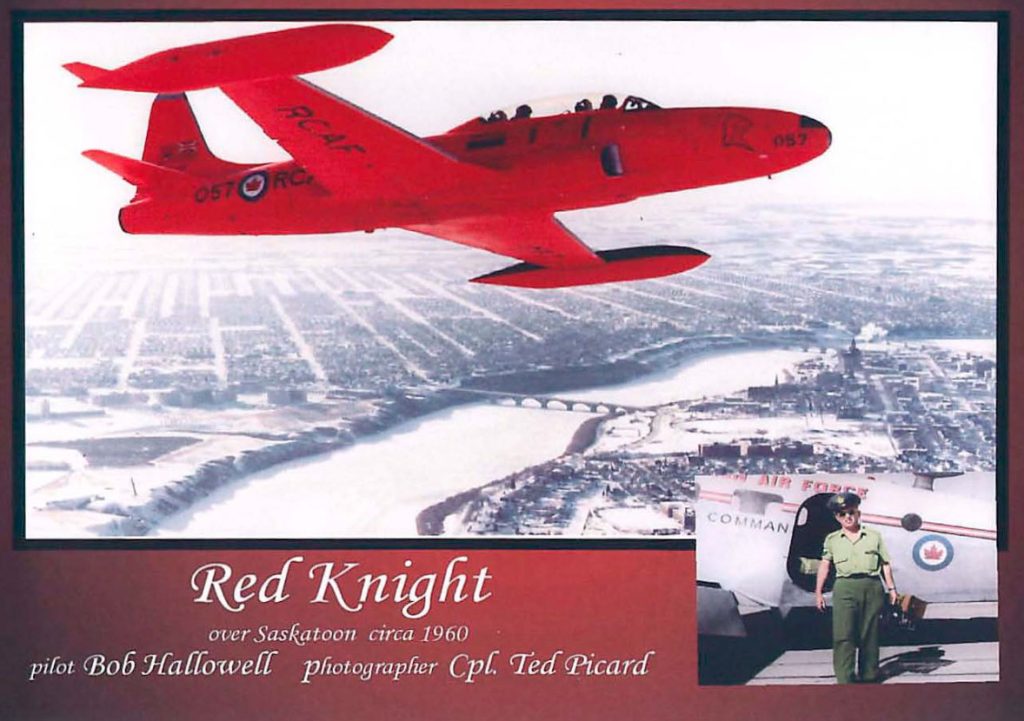
Ottawa wanted to know how this picture was done; needless to say it was no trouble getting the pilots and air craft together to again fly over Saskatoon. What do you think?
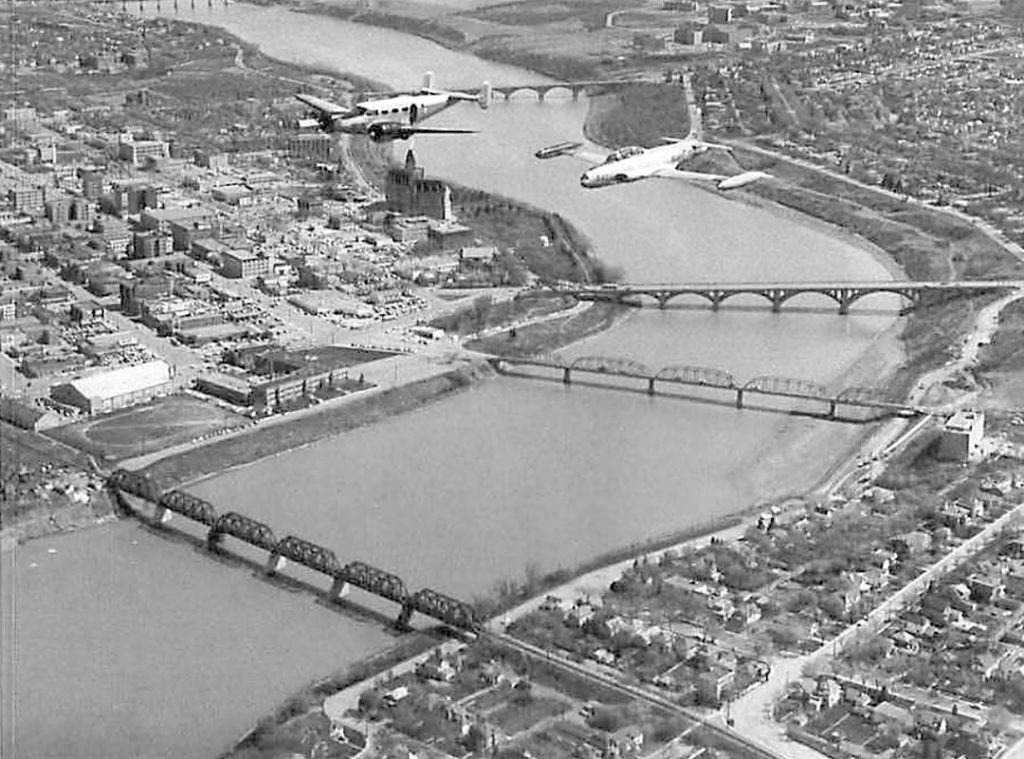
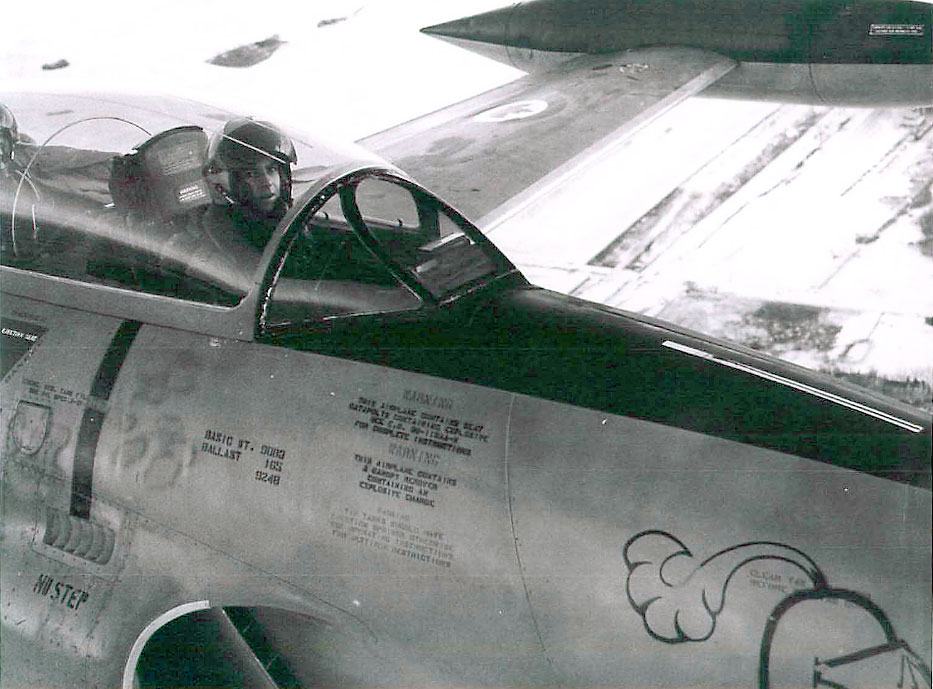
Close up of the pilot, Bob Hallowellon
On conclusion of the photo session, he frightened me, as I was sitting at the open door he came up to us and was so close that I asked him to remove his helmet so that I may take his portrait. Rest is history.
Note: this picture was taken in 1960 but he only saw the picture in Nov. 2007 which was of some great surprise to him.
Photo courtesy, Ted Picard.
In 1962 I got posted again – this time to Camp Borden, Ontario.
Camp Borden had it’s ups and downs. To start with, I was fortunate to be able to take over the running of the base theater, which brought in extra dollars, but at the same time, it took up a lot of my evenings. Then Luella took up golfing in a big way, which was good for her, as up to this time she were always tied up with six kids in the house. But then, golf took over much of her time. So much that the kids began to feel it and started to complain to me. But this was resolved in due time.
With winter here, our golfing friends thought we should also take up curling, so over to the curling club, and we were put on a rink with two good players to teach us the game. We both soon really fell in love with this game, and before we knew it the winter was over, and we were looking forward to the next year. But also at this time Gary and Cheryl are growing up, with Gary now getting involved with electronics and Cheryl falling in love.
Now guess what: 1965 and YES you guessed it, we are posted again, this time to Summerside, PEI. This time, I had to come alone to find accommodations and to let the kids finish their school year: it was a long drive by myself. However, arriving here I found out that because I was in charge of the photo section, and with the winter storm conditions I had to be on the base at all times. So, a three bedroom PMQ on 6th St would be available within a month or two. Meanwhile we had to get the children here early. So I was able to find accommodation with some of the families in the shop till we could move into a PMQ. Cheryl went to Sheila and Don Allan’s, and Gary went to George and Pat Price, and Judy to Ron and Jessie Roy’s. All three traveled to Summerside by train. And I guess it was quite an experience. Now when it was time to go back to Borden and pick up the rest of the family, Cheryl would not let me leave her here in Summerside. I’m sure, mainly because of the boyfriend back at Borden.
The schools here began two weeks early, so that when the potato harvest starts the school would break for two weeks so that the older boys and girls could help in harvesting the potatoes. I can remember Cheryl coming home and telling us about all the potatoes she would pick up and put in 50 lb potato sacks. Can’t remember what Gary was doing during this time, but I presume he would have been doing much the same. I guess it was about November, when we were given a four bedroom PMQ which included a garage, which was used as a work shop. I took my dining room furniture out to refinish and to my surprise it came out beautiful.
As we fell in love with what little curling we did at Camp Borden, we both wanted to get involved here. Upon making inquiries at the curling club, I was informed that because all the teams were already made up the only way we could get to curl was to find two more people to make up a team. The only people we knew on the base at this time were my co-workers in the photo section. None of them had ever curled, but one thought that he would like to try and would ask his wife to join too. Now can you imagine, two who never curled before, with Lou and I only having about two months at the game last year. Naturally with all my experience, Ted is the skip, Lou the mate along with Pat and George Price, we bravely marched on to the ice surface, shook hands with our opponents. Don’t recall the outcome, but am quite sure we did not win, but sure had a good time.
Both of us became quite proficient on the ice, good enough to try our luck on many bonspiels. I managed to get to three nationals representing the Legion, but Lou did much better as she took her rink to four national Senior Championships. We remained in Summerside, until 1970 when the airforce rules required me to retire. We still had three children at home and the three older ones starting their own lives. I continued photography through the hundreds of weddings I photographed over the years but made my living as a life insurance agent primarily with Maritime Life…. But that and the stories of my children are stories for another time…. Hope you have enjoyed this part of my life.
DAD
-ADDENDUM-
* Photographing King George & Queen Mary 1944
While serving in England during the war, one of the more interesting assignments that I was given, was to photograph King George, and Queen Mary, as they viewed the airmen on parade. Each time they stopped to speak to one of them, I was to take their picture and then later forward a copy to that person’s home town in Canada. Now I wish that I had made extra copies for myself, just to show you how close I was to them.
* Watching the buzz bombs 1944
Just before leaving Winnipeg when I was transferred overseas, my brother Leo’s wife Ruth said that if ever I get to London, that I should look up her Uncle Mr. Pickering, and gave me his address. On one of my first leaves I went to London I looked up Mr Pickering and visited for 2 days. He and his daughter lived in an area on the south ofLondon directly under the path ofthe buzz bombs heading to the center ofLondon.
First thing Mr Pickering showed me was the bomb shelter he had made for his daughter, which was basically a hole dug in his back yard with a corrugated oval metal cover on top. When the air raid sirens sounded, she would have to go out there, sometimes for the whole night. She had an extension cord and light and would take books to read while there.
To backtrack a little, when I found this address, I was surprised to see all the damage done to the house including all the windows had been completely shattered and wondered why he would stay there. To my question he said where would we go, I still have to get to work every day and my daughter is still attending school nearby, so we really have no choice. His wife was away at a hospital somewhere helping to look after the sick and injured bomb casualties in London proper.
He had many interesting stories about the war in his area. One of the most interesting was how the buzz bombs would fly, pointing a finger, about two blocks over from his home and added after we have a bite to eat he would show me around. It was hard to believe how people could go on living in such horrible conditions.
The sirens began to make their terrible noises about 9 o’clock, and that alone was enough to scare me. At that ,the daughter was ushered to her shelter and he motioned for me to come outside to watch the bombs fly over. At this point I wasn’t sure I really wanted to go out side, however, I followed. You could hear these very loud engines long before you could see them, and I quickly scanned the sky with the hope it would not be directly overhead. It did pass exactly where he said it would and maybe 10 or so seconds after it passed the engines stopped, followed by a loud explosion. I’m sure I could feel the displacement of the air. Well we only stayed out to watch the next one, when he said we should tum in for the night. That night I must have laid there for hours as the buzz bombs buzzed by, thinking all the time that they must be getting closer.
I must have finally dozed off only to be woken up about 4 or 5 in the morning by the explosion from the buzz bombs close enough that the house really shook. I laid awake then hoping to hear Mr. Pickering move around but he did not get up until 7 AM. He said that one did hit quite close, as there was a lot of dirt which blew into his room. After close examination, he pulled a piece of shrapnel out of the wall from over my bed. He handed it to me saying, this is the kind of stuff that has broken all our windows and done so much damage. Mr Pickering then told me this piece of shrapnel must have come in last night as it still feels warm. As I was looking at it, trying to figure how a piece so heavy could fly so far, he said with a laugh maybe you would like to take take it home as a souvenir. I did just that and was looking forward to getting back to Yorkshire.
Photo courtesy, Ted Picard.
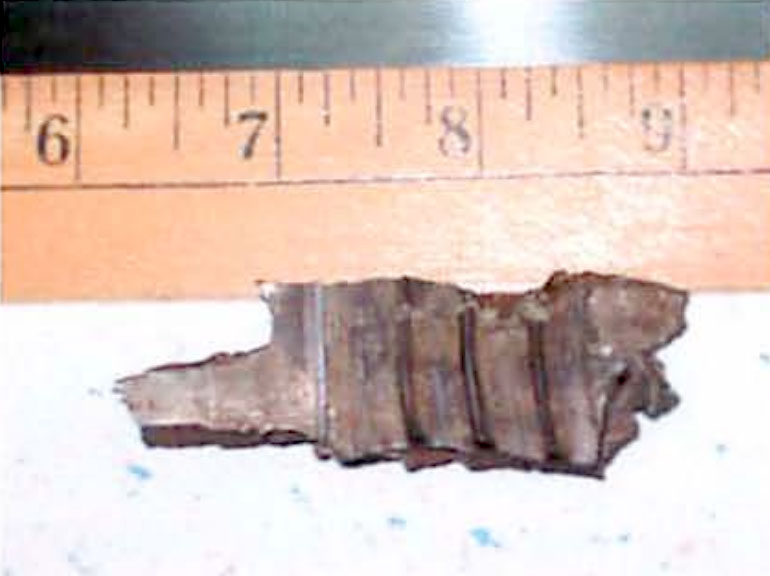
* 1957 Vancouver, B.C.
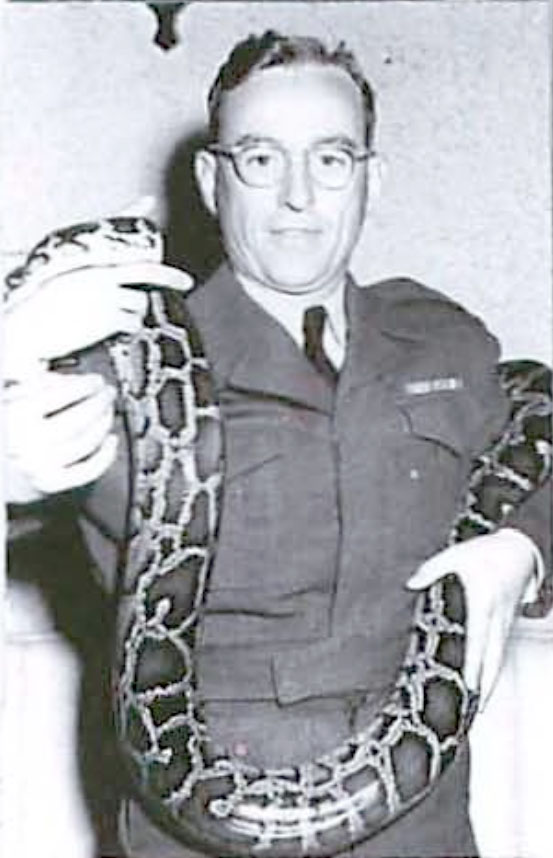
On one of my assignments, which was to photograph the Search & Rescue Squadron’s mascot, which of course was the 5 ft. Python snake, the photographer from the Vancouver Sun thought that it would only be right that I, as the Public Relations man for the Sqdn should be holding the snake, and before I knew it, I had this 40 some odd pound snake around my neck.
Never know what might happen when on assignment…
Photo courtesy, Ted Picard.
© Gilbert Edward (Ted) Picard, August 2006