

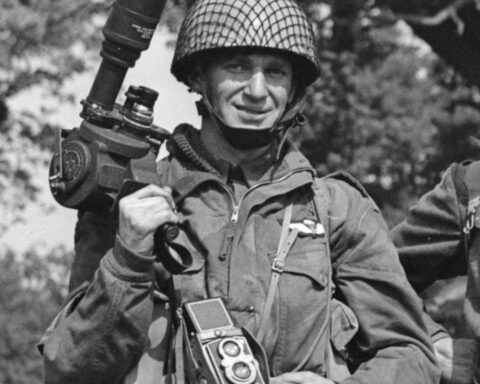
In Honour of Sgt. cameraman, Harry Henry Alfred Barnett, killed in action, March 11th, 1945, I am sharing additional information, courtesy of Ineke McCrea-Keeris, who left a comment to this post last month, (see below);
Ineke shared two documents. The first is a letter by Mr. G.W. Boss who noticed that the grave of Sgt Barnett was being cared for with fresh flowers, and wished to know who in the area it could possibly be…
I recently found a letter written in 1946 by a G. W. Boss to the Burgemeester (mayor) of Groesbeek where the Canadian Cemetery is located.
Mr. Boss had visited the grave of his friend H.H. “Barney”, Barnett and noticed flowers on the grave. His letter was aimed at discovering which Dutch family was caring for the grave and their address. The mayor of Groesbeek forwarded the letter to my father with a note that the letter referred to the grave my father had adopted.

The following document also shared by Ineke, is the letter from the Municipality of Groesbeek, dated December 20, 1946, to Mr. Keeris in Nijmegen regarding the “adoption” of a war grave—a common practice after WWII where local Dutch families cared for the final resting places of Allied soldiers.

Municipality of Groesbeek
To Mr. Keeris
Jos. Israelstraat 26
in Nijmegen
Groesbeek, 20 December 1946.
I hereby have the honor to send you a letter, which relates to the grave adopted by you. By putting you in contact with Mr. G.W. Boss, the opportunity would arise for you to find out the home address of and come into closer contact with the Barnett family.
Chairman N.O.C.
Dept. Groesbeek,(signature)
G.W. Boss would be no other than Gerard William Ramaut Boss, better known as Bill Boss, legendary Canadian war correspondent primarily known for his work during World War II and the Korean War.
I was curious to learn more of the connection between Boss and Barnett and located a document at Library & Archives Canada, titled, REVISED WAR ESTABLISHMENT – NO. 1 CDN. PUBLIC RELATIONS DETACHMENT – PERSONNEL – 17 DEC 1943, wherein, Capt. G.W. Boss, one of the conducting officers, appears on a long list of members of the Canadian Army Film Unit, and identifies, Pte. H.H.A. Barnett, who at the time was one of the staff drivers.
I also came across a series of correspondence that discuss personal letters for Pte. Barnett being forwarded to CMHQ in London, in hopes of reaching Pte. Barnett. A letter was written by then, Lt. G.W. Boss, 21st July, 1943…
“May arrangements be made, please, to include the attached personal mail for Tpr Barnett when the next batch is forwarded to PR personnel in Ops? (Signed) G.W. Boss Lt. Conducting officer, HQ 4 CDN Armd Div.”

The reply from HQ,“Reference your 4 PR/8-1-0 dated Jul 43 and enclosed personal mail for the marginally-named soldier, these letters have been forwarded to him today.”
Canadian Army Film and Photo Unit members operated in small, integrated teams that bridged the gap between different military ranks through shared danger and specialized duties. A typical field unit was comprised of only four or five people: usually one cine cameramen, one still photographer, a driver, and a conducting officer.
“Rank offered little protection on the battlefield; nearly one-third of the unit’s personnel were killed or wounded during the war. This high casualty rate, which affected everyone from the specialized cameramen to the support staff, further leveled the social hierarchy within the unit.” (Source: The Laurier Centre for the Study of Canada)
Special thank you to Ineke and the whole Keeris family.
I have no knowledge of any subsequent correspondence between my father and Mr. Bosch. However, the name Barnett has been engraved into my memory. When I was young, my family would often bicycle to the Canadian Cemetery to attend to the grave of HH Barnett, who as I understood at the time, was a Canadian soldier who had died in a plane crash. ( I always thought he was a pilot). There are pictures somewhere of us being there. My parents would tend to the grave and we would all pray for Mr. Barnett. In 1969 I emigrated to the U.S. and in all the years since, we visited the Canadian Cemetery in Groesbeek every time I was back there, often just to share WWII history with my husband , children, and friends.
…Now that I found this old letter to my Dad I have the exact location of the grave and will pass it on to my oldest brother who still lives in Nijmegen. And even though I am now 81 yrs old, I hope to go back again in ‘26 and visit those places that are so powerful in my memories.
The sacrifices of Canadian Soldiers and their families must never be forgotten.
Ineke McCrea-Keeris

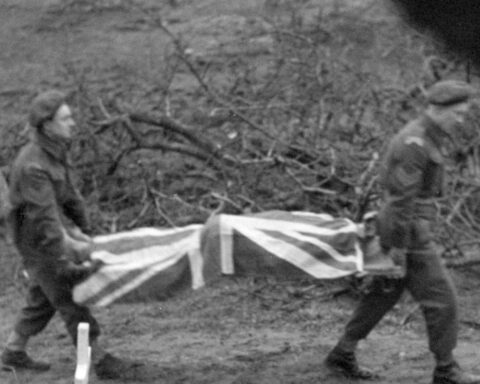
Above photo: Plane crash in which Sgt. H.A. Barnett of the No. 2 Canadian Army Film and Photo Unit died. Xanten (vicinity), Germany, 12 March 1945. Credit: CREDIT: B.J. Gloster/Library and Archives Canada/DND/PA-137037
REGIMENTAL number: D46110. No. 3 Canadian Public Relations Group.
BORN: 8th, December, 1920, Alberta. Next of kin not stated.
Additional person to be notified: Mr. George Hayward (Guardian), 121 Prospect Street, Sherbrooke, Quebec.
Religion: Church of England. Trade: Lathe worker
Language: English. Marital status: Single
“A well loved member of the Film Unit…Barnett would give the shirt off his back if the Army did not issue such nice ones…” Like many others in the Film Unit, Barnett would begin as a driver. Passing the camera course at Pinewood, Barnett became somewhat of a specialist in aerial photography, and had done a great deal of work flying low over the battles areas in an Auster observation plane.

“Sgt. Barnett had a standing assignment to secure aerial cine photographs of battle areas as required and when possible to arrange flights in Auster aircraft.
In the course of this duty, on 11 March he left advance Press Camp, MATERHORN, about 1330 hours to make a flight with Capt. Wilson of “C” Flight, 660 Air. O.P. Sqn, over the RHINE area.
At 2230 hrs the driver of the jeep which had gone to the air strip to pick up Sgt. Barnett reported to Capt. Fraser that the officers at the air strip had said the Auster had been shot down. Capt. Wilson was wounded but still alive in 3 Cdn. CCS. It was later found that he died on the morning of 12 March. Sgt. Barnett was believed to have been killed.
Early on the morning of the 12 March, Capt. Fraser went out to obtain further information. He finally located the wreckage of the plane about 5000 yards west of XANTEN, at MR 067413 (Germany 1/50000 Sheet 17). Sgt Barnett’s body had been taken out of the plane and placed on the ground. His pockets had been rifled and all that remained was a small knife.
From conversation with a gunner who had witnessed the action and from examination of the aircraft, it appeared that it had been attacked from above and behind by a Messerschmidt. The plane was badly shot up and crash landed in a field.
Sgt. Barnett had been shot several times from above through the right shoulder and back and in both hands. He was probably killed immediately.
His camera was slightly damaged but can be repaired. 100ft of exposed film was found, which has been sent to C.M.H.Q. for processing. He was known to have taken another 300ft up with him, but this is missing.
The body was buried on the afternoon of 12 March in a 2 Cdn. Div. cemetery at MR 098412 near XANTEN. Capt. D.V.A. Browne, Padre from H.Q. Adm Gp 4 Cdn Div, conducted the services. Sgt. Barnett’s personal effects are being forwarded to 2 Ech. in the regular way.
Signed J.E.R. McDougall, Major Officer Commanding, No. 2 Film & Photo Unit, No. 3 Public relations Group. 14th March 1945.

Not much is known about Sgt. Barnett before the war. Should you have any additional information you would like to share about Sgt. Barnett, please contact this website using the Contact, or Comments area.
© Dale Gervais 2026



Really interesting this. During the war my mother Annie Jansen lived in Nijmegen, in the occupied Netherlands. Nijmegen was liberated in September 1944 during Operation Market Garden, by the Canadian and American troops. During this time my mother met many Canadian soldiers as they were lodged at her parents home at Gerardweg 11 in Nijmegen. My mother was 18 at the time and during this time she became friends with Sgt Barnett. She often spoke about him, not quite sure this was a romantic affair but possibly. His nickname was “Barney”. She indeed told me that he was killed shortly before the end of the war. He was ultimately buried at a military cemetary in Groesbeek, near Nijmegen. This is the website https://www.cwgc.org/visit-us/find-cemeteries-memorials/cemetery-details/2063900/groesbeek-canadian-war-cemetery/ I have visited his grave many times, also after my mother passed away in 2016. Somehow feels like a link to my mothers wartime experience.
Hi Hans, thank you so very much for sharing this. Very little is known about Sgt. Barnett and his family background, so this is a wonderful addition about some of the people ‘Barney’ met during the war. It’s amazing that this ‘connection’ made an impression with your Mom and passed along to you. Possibly on your next visit to Groesbeek, it would be nice if you could take a picture of his gravestone for the website? Thanks again. Dale.
I recently found a letter written in 1946 by a G. W. Bosch (Boss) to the Burgemeester (mayor) of Groesbeek where the Canadian Cemetery is located.
Mr. Bosch had visited the grave of his friend H.H. “Barney”, Barnett and noticed flowers on the grave. His letter was aimed at discovering which Dutch family was caring for the grave and their address. The mayor of Groesbeek forwarded the letter to my father with a note that the letter referred to the grave my father had adopted.
I have no knowledge of any subsequent correspondence between my father and Mr. Bosch.
However, the name Barnett has been engraved into my memory. When I was young, my family would often bicycle to the Canadian Cemetery to attend to the grave of HH Barnett, who as I understood at the time, was a Canadian soldier who had died in a plane crash. ( I always thought he was a pilot). There are pictures somewhere of us being there. My parents would tend to the grave and we would all pray for Mr. Barnett. In 1969 I emigrated to the U.S. and in all the years since, we visited the Canadian Cemetery in Groesbeek every time I was back there, often just to share WWII history with my husband , children, and friends. The last time was about 2 yrs ago.
The only problem was that there is another Barnett buried there and I did not know the exact location of the grave. Now that I found this old letter to my Dad I have the exact location of the grave and will pass it on to my oldest brother who still lives in Nijmegen. And even though I am now 81 yrs old, I hope to go back again in ‘26 and visit those places that ate so powerful in my memories. This letter and the pictures, if I find them, I will give to my oldest son Sean who has shown a particular interest and was at the Cemetery before. The sacrifices of Canadian Soldiers and their families must never be forgotten.
I will post any picture I come across here as well.
Hi Regina,
Thank you so much for contacting me! Sgt. Barnett was a much loved member of the Army Film Unit, as told to me from the surviving veterans that I had the good fortune to interview.
I would love to see any photos you and the family might have regarding Sgt. Barnett, and even the letter you mention from Mr. Bosch. Did your family live close to where Sgt. Barnetts plane went down? I would love to hear any more details you might wish to share. I believe there is a picture of the wreckage. Maybe you will recognize the location?
Feel free to contact me directly here at;
Dale Gervais
Ottawa, CANADA
webmaster@canadianfilm.com
Hello Dale,
Thank you so much! I feel honored and wish my father would be alive to see that post. I’m sure he would have lots more to tell.
I still hope to find the few pictures I remember we had.
I’m so glad that anybody visiting the website will learn more about Sgt. Barnett and know that his sacrifice is recognized and honored by the people of the Netherlands.
Sincerely,
Ineke McCrea- Keeris
Hi Ineke – you are very welcome, and thanks to you, your father, and the whole family, for taking care of one of Canada’s fallen, during such a tumultuous time in world history.